Every fall from 1908, American Falls held Farmers' Day, a show of the district's crops meant to prove to newcomers what the country could grow. Arbon, some thirty miles southeast by the roads of the day, had a small but steady part in it, and the American Falls Press recorded it.
Arbon and American Falls were both in Oneida County then; Power County was created in 1913. Arbon's wheat was mostly dry-farmed, raised without irrigation, and from the first show dry-farm products had a prize of their own.
The first Farmers' Day
The first Farmers' Day was held on September 30, 1908. The Press promised about $200 in prizes, a speech by Senator Heyburn, a steer roasted in a pit, and sports from broncho busting to a greased pig. Joseph Arbon of Arbon was named one of five grain judges. Mrs. David Bolingbroke of Arbon was one of five women named to judge the dairy products, preserved fruits, pastries and house plants; she was probably Mary Ellen Thomas Bolingbroke of the Bolingbroke family. The first prize for wheat went to Homer Pease of Rockland.
Not a single product
In June 1909 David Burrell, the United States commissioner at American Falls, agreed to gather an exhibit of the district's dry-farm products for the Dry Farming Congress at Billings, Montana, that October. Arbon was on the list of places asked for samples, and the Blackfoot Idaho Republican carried the appeal too. By August the Press was again urging farmers to send products to a permanent display in Burrell's office, and it named the districts that had sent nothing:
Up to the present neither Rockland, Landing, Neeley nor Arbon have a single product on display. Aberdeen has but two contributors to the display, and Horse Island but two. ... Within a short time it will be impossible to go into the country and see a growing thing. Then an exhibit will be more than ever necessary, and the community which makes none will suffer in comparison with others that have been more thoughtful.
In September 1909 Farmers' Day was given a permanent association. T. B. Evans of Arbon was one of its five vice-presidents, and he was named again in 1910, when E. E. Zaring of American Falls was president. Whether any Arbon samples reached Billings is not known.
In August 1910 the association decided to give prizes for whole-district displays if the districts took enough interest, and the Press urged the Arbon valley to gather "a creditable display."
Dry-land alfalfa
In July 1911 the Press asked Arbon and the other districts to save grain samples for an exhibit train through the East, "to show that good grain is the rule, and not the exception."
That year the Press praised Arbon's alfalfa. On August 8, 1911, samples from W. S. Hays's ranch at Arbon were brought in to town. His dry-land alfalfa, from a spring seeding, stood twenty-seven inches, and his wheat thirty-one. To the paper the alfalfa was "its own evidence of the fertility of the soil and its capacity to store and retain moisture." He was probably Willis S. Hays, whose homestead toward the south end of the valley was patented in 1912.
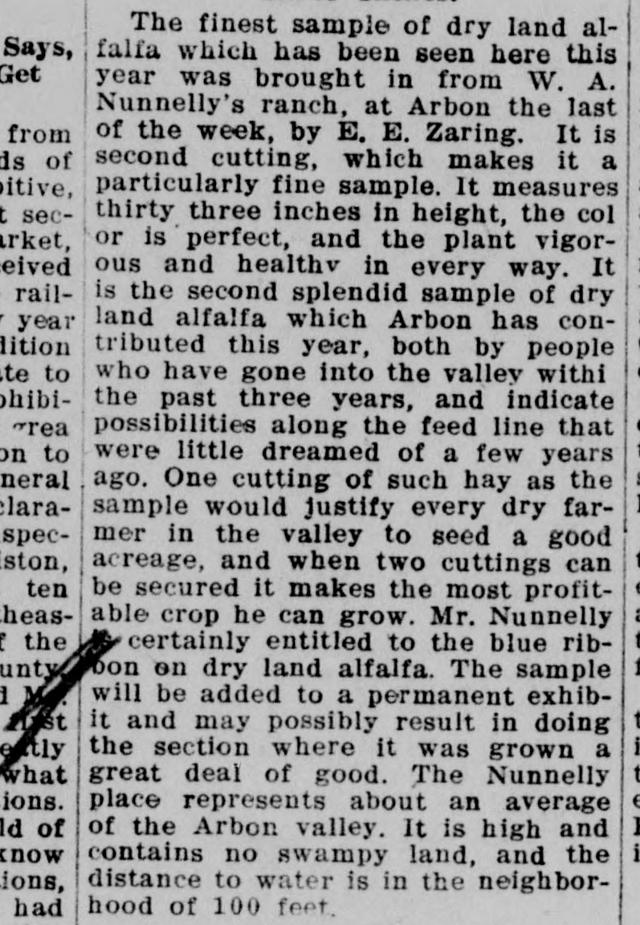
Early in September E. E. Zaring brought in a second sample, from W. A. Nunnelly's ranch at Arbon:
It is second cutting, which makes it a particularly fine sample. It measures thirty three inches in height, the color is perfect and the plant vigorous and healthy in every way. It is the second splendid sample of dry land alfalfa which Arbon has contributed this year, both by people who have gone into the valley within the past three years, and indicate possibilities along the feed line that were little dreamed of a few years ago.
Nunnelly, the paper said, was "certainly entitled to the blue ribbon on dry land alfalfa," and the sample would go into a permanent exhibit. His place was about average for the valley: high ground, no swampy land, and water about a hundred feet down. The Caldwell farm paper The Gem State Rural reprinted the item on October 1. W. A. Nunnelly (Nunnelley on this site) had moved his family onto homesteads at the Summit end of the valley in August 1909 and, by the family's telling, come through a hard first winter. In September 1911 his barley promised a little over forty bushels an acre.
The fourth Farmers' Day was set for September 28, 1911, in the Odd Fellows hall at American Falls, with a premium for the best display of dry-farm alfalfa. The Press also said Ellsberry's store would give a Star hat for the best dry-land alfalfa, though its own list of special prizes gave the hat for fruit. The shows, the Press wrote, had provided "object lessons which homeseekers could not ignore." Whether Nunnelly or Hays entered is not known.
From Farmers' Day to Farmers' Fair
In August 1912 the American Falls Board of Trade renamed the association the Farmers' Fair, made David Burrell its president, and chose a director for each farming district. Arbon's was a Ripley, printed as H. H. Ripley one week and B. Ripley the next; he was probably D. B. Ripley, whom the Press placed at Arbon in 1911 and 1913. The director for Crystal was W. C. Snyder, whose homestead there had been patented in 1910. The Press explained what the fair was for:
This is not alone a contest to see who can raise the biggest pumpkin or cabbage, but rather a get together party, when we can talk with those in the same business and see what they have done and show what we have done ...
After the fair, held in late September, the Press listed the district's delegates to the International Dry Farm Congress at Lethbridge, Alberta, in October, and Joseph Arbon, named a grain judge for the first Farmers' Day, was among them. In September 1913 Governor Haines named him among Idaho's delegates to the next congress, at Tulsa, Oklahoma, and Mrs. Joseph Arbon among Idaho's delegates to the International Congress of Farm Women meeting with it. No report has been found of whether they went.
What is not known
The prize reports found for these years name winners from Rockland, Landing, Igo, Pleasant Valley and near American Falls, but no one from Arbon. The fuller lists printed after most shows have not been found, so whether an Arbon grower took a ribbon is not known. The earliest prize for valley wheat this site has found is John H. Bullock's, at the Idaho Seed Show in December 1914; see the first valley wheat at a world's fair.
On this site: the Arbon family and the Evans family.
Sources
- American Falls Press, September 19, 1908, page 1
- American Falls Press, November 21, 1908, page 1
- American Falls Press, June 19, 1909, page 1
- Idaho Republican (Blackfoot), July 30, 1909, page 6
- American Falls Press, August 14, 1909, page 1
- American Falls Press, August 14, 1909, page 4
- American Falls Press, September 4, 1909, page 1
- American Falls Press, August 13, 1910, page 1
- The Gem State Rural (Caldwell), September 1, 1910, page 18
- American Falls Press, September 10, 1910, page 1
- American Falls Press, March 11, 1911, page 6
- American Falls Press, July 20, 1911, page 1
- American Falls Press, August 10, 1911, page 1
- American Falls Press, September 7, 1911, page 1
- American Falls Press, September 14, 1911, page 1
- American Falls Press, September 21, 1911, page 1
- The Gem State Rural (Caldwell), October 1, 1911, page 32
- American Falls Press, August 15, 1912, page 8
- American Falls Press, August 22, 1912, page 1
- American Falls Press, October 3, 1912, page 1
- American Falls Press, October 3, 1912, page 4
- American Falls Press, September 11, 1913, page 8
- Idaho Republican (Blackfoot), September 26, 1913, page 3
- Homestead patent to William C. Snyder, March 10, 1910 (IDBL 0002301)
- Homestead patent to Willis S. Hays, December 7, 1912 (IDBL 0005950)
- Homestead patent to Walter A. Nunnelley, July 7, 1915 (IDBL 0005798)
- Homestead patent to Mamie Nunnelley, July 7, 1915 (IDBL 0005799)