In October 1923 two days of bidding between rival grain buyers at Schiller, the railroad siding where Arbon Valley's wheat was shipped, raised the price of wheat across Power County. That winter the valley's schoolchildren reported in the county paper how the crop was hauled out to the siding.
The valley had no railroad. Arbon, Pauline and Crystal had been in Oneida County until 1913 and were now in Power County, and their dry-farm wheat went out in sacks to sidings on the Oregon Short Line. Schiller was one of them, about a mile west of today's Bannock Peak Truck Stop on I-86, as the Pauline and West Fork history places it. At Pauline the grain was taken in at the warehouse across from the school. In November 1922 the American Falls Press reported E. C. England of Pauline's figure for grain handled at "the warehouse" in October as 29,008 bushels; two weeks later it corrected this to 29,008 sacks, about 60,000 bushels, and called the place the Arbon Warehouse, probably the one at Pauline.
Two days of bidding
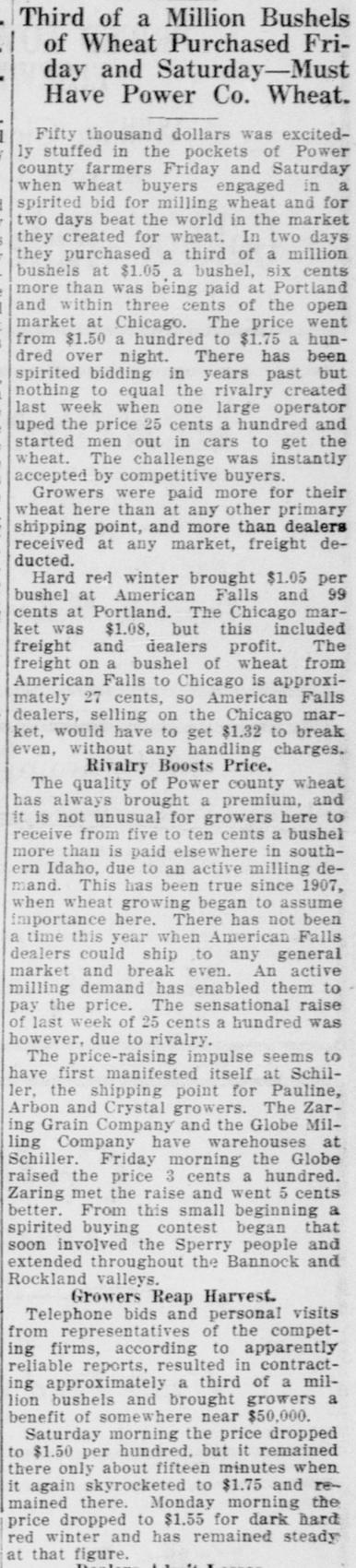
On October 18, 1923, the Press put the story on its front page: "Fifty thousand dollars was excitedly stuffed in the pockets of Power county farmers Friday and Saturday when wheat buyers engaged in a spirited bid for milling wheat and for two days beat the world in the market they created for wheat."
The Friday and Saturday were October 12 and 13. In those two days, the paper said, buyers took about a third of a million bushels, and the price went from $1.50 to $1.75 a hundred pounds overnight. At 60 pounds to the bushel, $1.75 a hundred came to $1.05 a bushel, six cents more than Portland was paying. Power County wheat had brought a premium since 1907 because of a strong milling demand, the Press explained, but this jump of 25 cents a hundred was "due to rivalry," and it seems to have begun at the valley's own shipping point:
The price-raising impulse seems to have first manifested itself at Schiller, the shipping point for Pauline, Arbon and Crystal growers. The Zaring Grain Company and the Globe Milling Company have warehouses at Schiller. Friday morning the Globe raised the price 3 cents a hundred. Zaring met the raise and went 5 cents better. From this small beginning a spirited buying contest began that soon involved the Sperry people and extended throughout the Bannock and Rockland valleys.
Bannock valley was the older name of the Arbon valley. Telephone bids and visits from the competing firms' men, by "apparently reliable reports," brought growers somewhere near $50,000. On Saturday morning the price dropped back to $1.50 for about fifteen minutes, then returned to $1.75. By Monday it had settled at $1.55 for dark hard red winter wheat. The dealers admitted what it had cost them:
Dealers freely admit that they bought all the wheat they wanted at the high prices. They confess to losses, but accept them philosophically. They apparently take satisfaction in the volume of business done, and forget the unpleasant features.
The Press did not say how much of that wheat came from the valley.
Hauling to the switch
That winter the Press printed news sent in by pupils of the county's rural schools, who noticed the hauling. In mid-November a column of Pauline-area news counted about twelve trucks hauling "out of here," all with big loads. A Pauline pupil explained the work in a sentence: "Mr. T. D. Lusk is freighting that means going to and from the switch and the switch means Schiller." The site's Lusk family history takes him to be Dave Lusk of Pauline.
In early December an Arbon school column reported that the trucks had stopped because of snowstorms. A week later the Pauline pupils wrote that the trucks were not hauling from the warehouse because they were "filled up" at Schiller, and the week after that they were freighting again. On January 3, 1924, the Valley View column reported that Heber Wood had gone to Schiller with a load of wheat.
The haul went on into spring. In early March the Armstrong school, between Pauline and Crystal, reported that E. P. Armstrong, M. J. Crump, F. Barnett and R. Wheatley had gone to Schiller with a load of wheat, and the Valley View pupils wrote that Ralph and Lee Hatfield were freighting grain from Pauline to Schiller. On March 13 a Pauline pupil reported: "1617 sacks were taken out of the warehouse at Pauline last Monday and freighted to the railroad down at Schiller, 26 miles away." At about two bushels to the sack, that was more than 3,000 bushels. In lines the scan has jumbled, the same column seems to say that the freighting had stopped because there was no room at Schiller for more wheat.
A week later the hauling had started again at Pauline. On March 27 the Pauline column reported: "The grain company has stopped hauling grain to Schiller." In the same column, "Bob Swim has been freighting with ten head of horses." He was Bob Swim, who had married Nell Roper of Pauline. The columns do not say whose grain company it was, or when the last of the 1923 crop left Pauline.
Later in the decade
By 1927 the valley's growers were talking of storage of their own. In late February the Salt Lake Tribune reported that they had recently met at Pauline and named a committee to look into a warehousing organization; the Tribune's next report gave its members as Ed England, William Allard, T. H. Hill, Carl Rudeen and J. H. Keeler. On March 7 the committee, joined by Dave Lusk and others, met at the Pocatello chamber of commerce with County Agent L. E. Tillotson presiding. The scan of the Tribune's report is scrambled, but it seems to say that they had a price on the warehouse at Schiller, then owned by a Strauss company of Portland, Oregon. The papers found so far do not say whether they bought it.
By then the Tribune was also reporting Arbon Valley wheat at Michaud, on the railroad west of Pocatello. In August 1928 it said more Power County red wheat was coming out of the valley than ever before, so much that even with a large addition to the Michaud warehouse, much of the crop would have to be piled in the open. A year later a new 110,000-bushel warehouse at Michaud was nearly half full, with sacked wheat being brought in by Arbon Valley farmers and shipped to the Pocatello mill as needed.
On this site: the first grain warehouse, the first trucks, and the history of Pauline and West Fork.
Sources
- American Falls Press, November 16, 1922, page 8
- American Falls Press, November 30, 1922, page 5
- American Falls Press, October 18, 1923, page 1
- American Falls Press, November 15, 1923, page 8
- American Falls Press, November 29, 1923, page 2
- American Falls Press, December 6, 1923, page 2
- American Falls Press, December 13, 1923, page 6
- American Falls Press, December 20, 1923, page 2
- American Falls Press, January 3, 1924, page 2
- American Falls Press, March 6, 1924, page 1
- American Falls Press, March 6, 1924, page 4
- American Falls Press, March 13, 1924, page 2
- American Falls Press, March 20, 1924, page 2
- American Falls Press, March 27, 1924, page 2
- Salt Lake Tribune, February 27, 1927, page 25
- Salt Lake Tribune, March 8, 1927, page 11
- Salt Lake Tribune, August 26, 1928, page 31
- Salt Lake Tribune, September 2, 1929, page 10