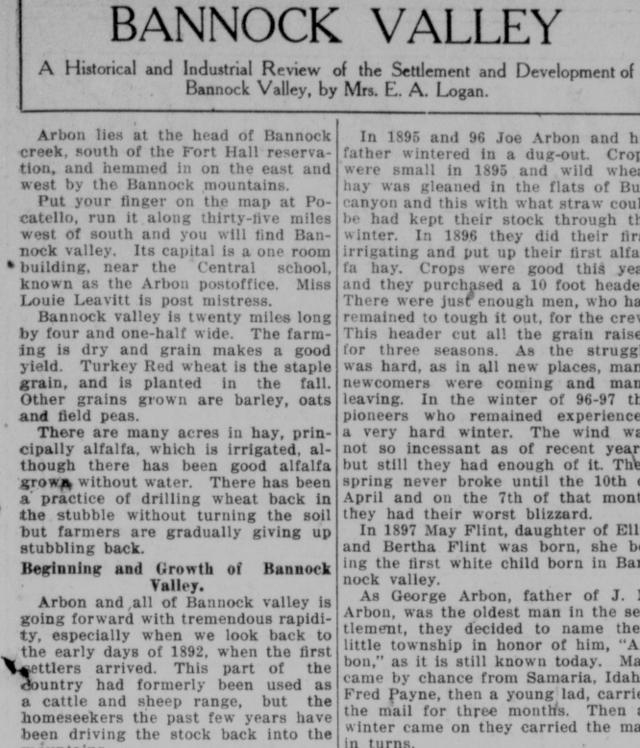
On March 29, 1917, the American Falls Press printed a special "Industrial Edition," and its page 7 carried "Bannock Valley: A Historical and Industrial Review," by Mrs. E. A. Logan of Arbon. It tells how a few squatters took up the valley in the 1890s. The site counts it as the valley's first written history, and many of the Stories' "firsts" come from it.
Mrs. Logan, whom the site identifies as Jennie Logan, was a newer settler; her husband, she wrote, had quit firing locomotives seven years earlier to take up 160 acres.
Snow in Knox Canyon
She began with directions: "Put your finger on the map at Pocatello, run it along thirty-five miles west of south and you will find Bannock valley." When the first settlers came, the valley was in Oneida County; Power County was created from it in 1913.
The first settlers came in 1892, into what had been cattle and sheep range. The digitized text of the page is too garbled to show who made up the first party, but not their first difficulty: there was still so much snow in Knox Canyon that they could not tell whether a creek ran there. Later that summer they found a good stream and started a canal to bring it down to the valley. Her lists of the original pioneers name D. J. Bowen, E. J. Wright, George Arbon and his son J. N. (Joe) Arbon, E. H. Davis, L. B. Evans, W. T. Hawkins and Hy. E. Davis.
In 1893 J. N. Arbon, H. Davis, E. H. Davis and D. J. Bowen staked out their land. Because it was unsurveyed, they held it by squatters' rights, by living on and working it. In 1920 she wrote: "The land in the valley had not been surveyed when they arrived so all took advantage of 'squatters rights' and settled on the land that most of them now own."
The canal reached the mouth of the canyon, and the first spring they raised enough vegetables and small fruits for the winter. Then she came to the first cabin:
D. J. Bowen was the proud possessor of the first cabin. It was made of hewn logs with a dirt roof and he had to haul the lumber for the floor from Elkhorn, near Malad City.
"Many of the pioneers moved into town for the winter but a few stuck it out." The Anderson brothers, probably the brothers of this site's Andersen family, "camped in a wagon box," in a year the digitized text has garbled.
The first harvest
In 1894 a group that included Bowen, the Arbons and Bailey "bought wire to fence each a small proportion of land and put in grain." Bowen bought an Osborne dropper, a reaping machine, and because the grain was too short to bind into sheaves it was hauled in wagons. A thresher came from Samaria, near Malad. Bowen's crop came to 63 bushels and Arbon's to 100. Cold weather had set in by the time the late threshing reached the Anderson boys' place, so the crew left the machine "between the stacks" and finished the next spring.
In 1895 and 1896, she wrote, Joe Arbon and his father wintered in a dugout. Joe's own memory of their first winter, which he recalled as spent in a cabin and which may have been an earlier year, is in Smoke and snow in the Arbons' first winter. She went on:
Crops were small in 1895 and wild wheat hay was gleaned in the flats of Bull canyon and this with what straw could be had kept their stock through the winter. In 1896 they did their first irrigating and put up their first alfalfa hay. Crops were good this year and they purchased a 10 foot header. There were just enough men, who had remained to tough it out, for the crew.
"This header cut all the grain raised for three seasons." Newcomers came and went, and the winter of 1896–97 was very hard for those who stayed: "The spring never broke until the 10th of April and on the 7th of that month they had their worst blizzard."
The name
She then told how the settlement got its name: "As George Arbon, father of J. N. Arbon, was the oldest man in the settlement, they decided to name their little township in honor of him, 'Arbon,' as it is still known today." Bowen became postmaster in 1898, and in the fall of 1900 George Arbon, Bowen and a Daniels were judges at the first election.
Her history runs on to the homestead rush of 1908 and to a valley that hoped one day to "hear the brakeman call 'next station, Arbon.'" Of the first pioneers, J. N. Arbon, D. J. Bowen, J. R. Bailey, E. H. Davis, L. B. Evans "and the Anderson boys" were still there.
Grandpa Arbon's birthday
Mrs. Logan told the story again on the Press's front page of January 9, 1920, as "Arbon Pioneers Were Resourceful Farmers," this time around George Arbon. She closed:
Joe Arbon has a splendid farm, his pioneer squatter's claim, and has prospered. His father now resides in Malad. He is still quite hale and hearty considering his age. His many friends here extend to "Grandpa" Arbon their best wishes for a happy birthday and hope that he will enjoy many more of them.
The Arbon column in the same issue reported that Mr. and Mrs. Jerry Baker had gone to Malad for the 80th birthday of her father, George Arbon, a family reunion at the Malad home where Joe was wintering. The life story printed at his death counts the guests as "forty-five in all." George Arbon died at Joe's home in Malad on March 22, 1921, after a stroke; his body was to be taken to Willard, Utah, for burial beside his wife.
Where the accounts differ
Her versions differ: the hard winter is 1896–97 in 1917 and 1895 in 1920, and in 1920 the town had borne Arbon's name "since 1895," though the first post office, named Arbon, was applied for in 1898. The 1920 piece brings George Arbon in with the party of 1892, as a Press profile of Joe did in November 1917, and the 1917 history counts him among the original pioneers; his biography says 1893, and the Arbon family page finds no record made at the time that places an Arbon in the valley before 1898. The Andersen accounts give the first house to Otto Andersen.
On this site: the Arbon area history and the first harvesting machines.
Sources
- American Falls Press, March 29, 1917, page 7
- American Falls Press, March 29, 1917, page 1
- American Falls Press, November 6, 1917, page 3
- American Falls Press, January 9, 1920, page 1
- American Falls Press, January 9, 1920, page 4
- American Falls Press, March 25, 1921, page 2
- American Falls Press, April 1, 1921, page 1
- American Falls Press, April 1, 1921, page 8