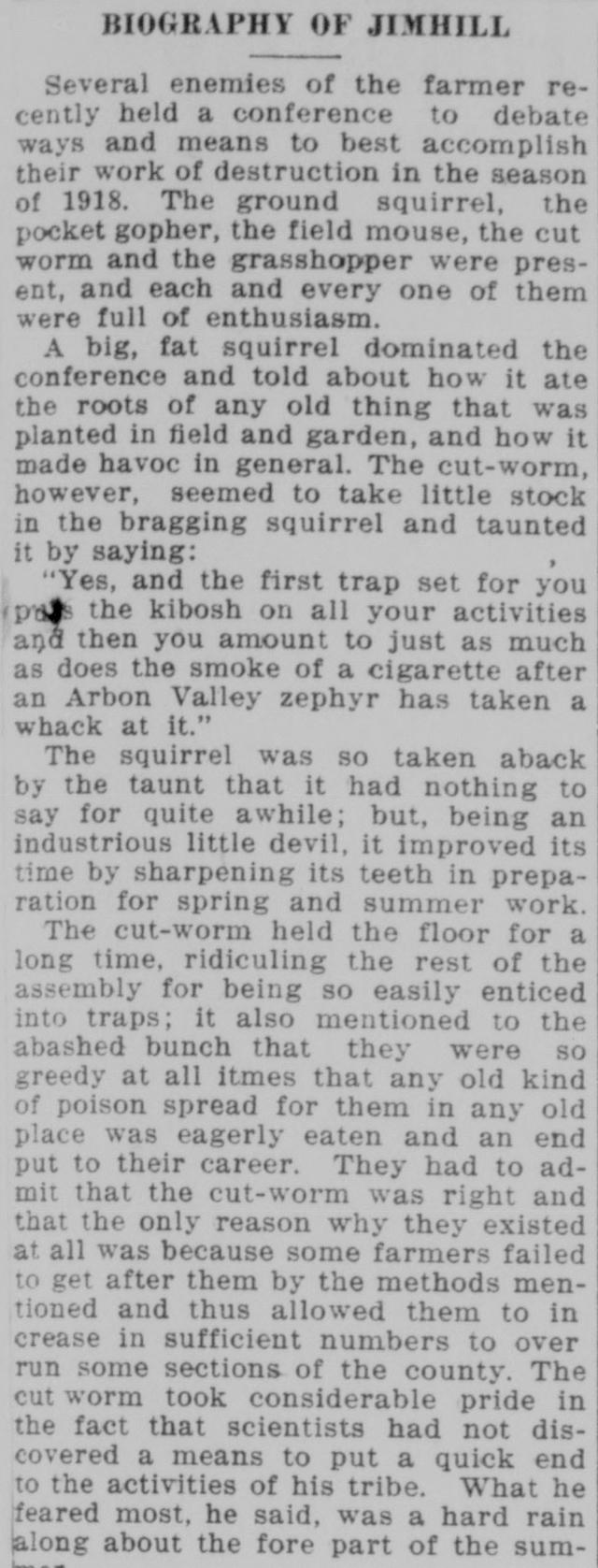
In the fall of 1917 the wheat farmers of Arbon Valley had one problem above all others: Jim Hill mustard, a weed that, once dead, rolled before the wind as a tumbleweed, still full of seed. The American Falls Press's farm writer, who signed himself "the Pilgrim," heard about it all over the valley, and in January 1918 he let the weed speak for itself.
A newcomer in the fields
In June 1915 an item among the Arbon news reminded readers, "Don't forget to pull the weeds," since the Jim Hill mustard was "getting quite numerous in the fields since the rains." D. J. Bowen later told the Pilgrim it had appeared on his ranch only in the last three years.
In September 1917 rain kept the mustard green, and many fields stood uncut while their owners waited for it to ripen. In October the Arbon column reported that Marsdon Tallon (printed Talion) had "a fine stand of Turkey Red wheat but the old Jim Hill has got almost the best of it, making it almost impossible to combine it." Tallon sent a separate header ahead of the combine to cut off the mustard tops, with Roy Porter driving the combine behind. "There are more ways than one of harvesting," the column remarked.
J. N. Arbon cut back his fall seeding because of the weed, and on T. B. Evans's promising stand "the mustard very materially cut down the yield."
Spring seeding, or the Washington way
The Pilgrim found the valley's growers "practically a unit": sow only in the spring for two or three years and accept "a few bushels less per acre." F. W. Swim, three miles south of Pauline (probably Frank Swim), planned mostly spring grain for 1918 and had raked up and burned a great deal of frost-killed mustard. D. P. Ripley, as printed (probably David B. Ripley of the east side), would seed mainly in spring for at least two years, counting on the weed law and the "co-operation of all farmers—with the emphasis on 'all.'"
Tallon disagreed. In eastern Washington, where he had grown wheat for fourteen years, he had seen mustard that "stood as high as a horse's back," and farmers there had beaten it with deep summer fallow, scraped with a "weed skinner," a twelve-foot steel blade drawn two inches under the surface whenever weeds showed. He saw no need to rely on spring seeding alone. Two valley families each credit their own pioneer with first summer-fallowing, resting a field for a season to store moisture.
The neighbors and the weed law
Worse was a neighbor's mustard. On November 20 the Pilgrim wrote:
Many of the farmers around Arbon have done their utmost to keep their lands free from mustard and other weeds, working with harrow, weeder and hoe to keep the pest out. In spite of all their efforts the mustard got the upper hand because some other rancher adjoining them left his land and went to reside in some other county or state, refusing to lease the land except on grasping and exorbitant terms.
Near Crystal, Jacob Meitzenheimer hoped the new law would reach owners who abandoned their places and were "commonly referred to as the 'weed farmers.'"
In July 1917, at the county farm bureau's request, the commissioners of Power County, which had taken in Arbon Valley from Oneida County in 1913, gave notice that the state weed law would be enforced from 1918. Where an owner would not clear his land, the county could have it done and charge the cost to his taxes. The law, the Press said, was "aimed particularly at mustard."
The weed speaks
On January 22, 1918, the Pilgrim printed "Biography of Jimhill." The ground squirrel, pocket gopher, field mouse, cutworm and grasshopper meet "to debate ways and means to best accomplish their work of destruction in the season of 1918." Then a bunch of mustard rolls in and takes over. The others sleep through the winter, it sneers: "Here it is almost the close of the year and still I am at work day and night, spreading seed right and left so it will have an early start in the spring."
It also recalls a farmer at Crystal:
One man over at a place called Crystal had a thundering idea last fall, though. We had covered his field so thick with our growth that when he came along one Sunday morning he put up a harsh line of talk and came near blistering us with the warmth of it; then he went home and came back in a little while and ran an apparatus across the field that laid whole rows of our tribe low.
A few days later he set the rows alight with matches, and then did the same in other fields. "That surely was a warm experience for us," the weed admits.
The weed's friend is "the fellow who gets title to some land and then hikes to some town or other instead of cultivating his farm. The day he leaves we take possession and in a few months we are master." This one was "raised on an abandoned ranch west of Pauline." Under the new law, if such an owner will not clean up, the county will do it and "make our friend pay for it, too." A Russian thistle tumbles in to dispute the mustard's claim to be the farmer's chief enemy, and the fable ends with its warning that if the farmers get together, "we'll roll down to destruction together."
Spring 1918
In April the Crystal column reported that B. W. McClain was "plowing his summer fallow land all over again," because some adjoining farms were so infested with mustard that he could not otherwise seed it. The papers read here do not say how the 1918 crop fared, or whether the valley formed a weed district. In January 1919 C. R. Butterfield of Crystal was proposed as the county farm bureau's executive committeeman for weed control.
The Pilgrim had already offered a last word, on November 30, 1917:
There is no question that the weed will be eradicated from the fields of this county by the united efforts of the wheat growers and the enforcement of the weed law, but it has been urged that at least one of the Jim Hill plants in first class working order be preserved and sent to the Smithsonian institute in Washington so that future generations may see what a formidable pest their forbears had to fight.
Sources
- American Falls Press, June 17, 1915, page 1
- American Falls Press, July 10, 1917, page 1
- American Falls Press, July 24, 1917, page 1
- American Falls Press, September 7, 1917, page 8
- American Falls Press, October 5, 1917, page 3
- American Falls Press, October 9, 1917, page 4
- American Falls Press, October 26, 1917, page 3
- American Falls Press, November 6, 1917, page 3
- American Falls Press, November 20, 1917, page 3
- American Falls Press, November 27, 1917, page 3
- American Falls Press, November 30, 1917, page 3
- American Falls Press, December 14, 1917, page 3
- American Falls Press, January 22, 1918, page 3
- American Falls Press, April 23, 1918, page 4
- American Falls Press, January 24, 1919, page 1