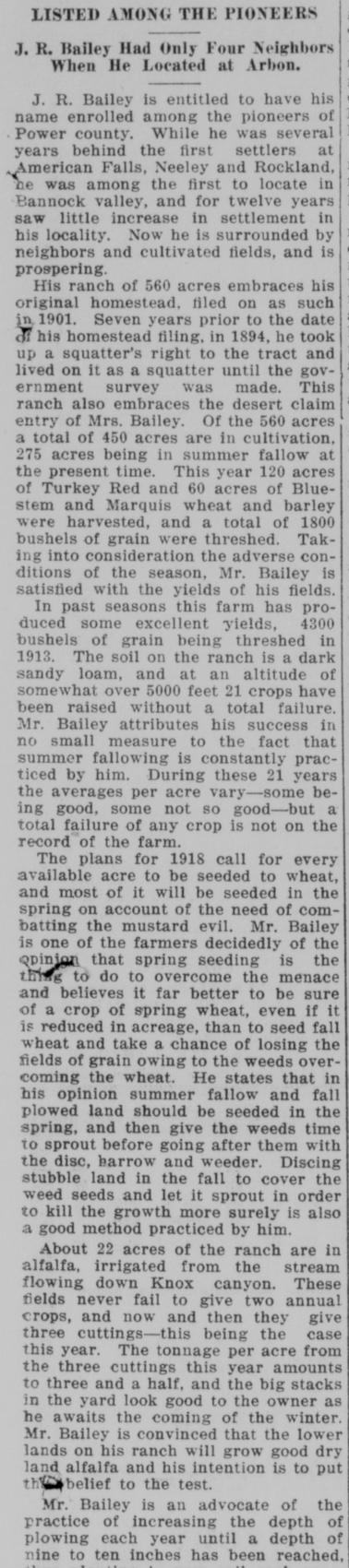
On November 20, 1917, the American Falls Press printed its farm writer's profile of J. R. Bailey and his ranch at Arbon, in the valley once called Bannock Valley; the writer signed himself "The Pilgrim." In June 1940 the Ogden Standard-Examiner marked James R. and Annie Bailey's fiftieth wedding anniversary. With the obituaries that followed, these pieces tell the story of one of the valley's founding families.
Among the pioneers
The profile's headline said J. R. Bailey "Had Only Four Neighbors When He Located at Arbon." Arbon had been in Oneida County until 1913, when it became part of the new Power County, and the Pilgrim counted Bailey among that county's pioneers. He wrote that Bailey was among the first to settle in the valley, and "for twelve years saw little increase in settlement in his locality." In 1894 he "took up a squatter's right to the tract and lived on it as a squatter until the government survey was made." Unsurveyed land could not yet be entered as a homestead; he filed on his in 1901. By 1917 the ranch covered 560 acres, including a desert-land claim entered by Mrs. Bailey. Of the couple's start there, the Pilgrim wrote:
When J. R. Bailey and his wife came to their present home in 1894 he had only four neighbors. They went to work clearing and breaking the sagebrush lands and putting in crops long before the land was surveyed and opened to entry. Their first domicile was a tent and later a log cabin was built for the family. Still later a frame dwelling was erected and is now occupied by the family.
In the adverse season of 1917 the farm threshed 1,800 bushels of grain, which Bailey thought satisfactory, against 4,300 in 1913. The Pilgrim also gave the farm's longer record:
The soil on the ranch is a dark sandy loam, and at an altitude of somewhat over 5000 feet 21 crops have been raised without a total failure. Mr. Bailey attributes his success in no small measure to the fact that summer fallowing is constantly practiced by him. During these 21 years the averages per acre vary—some being good, some not so good—but a total failure of any crop is not on the record of the farm.
Summer fallowing meant leaving a field unplanted for a season and working it to kill weeds and store moisture. Other families are credited with bringing it to the valley, as the summer fallowing entry shows; the Pilgrim claimed no first for Bailey. He also noted alfalfa watered from the stream in Knox Canyon, a registered Percheron stallion, twelve cows whose butter was sold, and fifty Plymouth Rock hens.
The profile also covered the children's schooling. The year before, four Bailey daughters at the Central school had been "neither absent nor tardy" all term, through an exceptionally severe winter, and a son was now at high school in Hyrum, Utah. "For seventeen years Mr. Bailey was postmaster at Arbon," the Pilgrim added, and he was chairman of the school trustees. The appointment records summarized on this site show two terms as postmaster, 1900 to 1903 and 1906 to 1916, with Susannah Evans holding the post office between.
Toward its close, the profile turned to how the Baileys had begun:
When they came to the valley these pioneers had ten cents in actual cash capital, some debts, two cows and a small flock of chickens. While poor in material wealth, they had plenty of energy and even more raw material to expend it upon.
Two golden weddings
Annie Bailey, whom the papers called Anna or Ann, was a daughter of Thomas and Jane Kerr. She and James were both born in Wellsville, in Utah's Cache Valley. In December 1922 the Press's Arbon column reported, in a line the scan has garbled, that the J. R. Baileys had left for Wellsville for the golden wedding of Mrs. Bailey's parents, and the Logan Journal's Wellsville column confirms that they came.
Their own fiftieth anniversary fell on June 11, 1940. The November before, their youngest son, Earl Kerr Bailey, born at Arbon in 1913, had died in a Pocatello hospital. On June 13 the Standard-Examiner told how the couple, married in the Logan temple in 1890, went straight to Huntsville, Utah, where he laid track for a railroad between Ogden Valley and Ogden. Three months later they moved on to work on the Bear River canal system, and Bailey recalled that they took with them "our first and only possession—the greased pig," which he had caught in a July contest at Huntsville. The pig was long gone, the paper said, but the Baileys were still going strong. It gave 1894 as the year they settled in Arbon and counted nine living children. The family's own telling is in James R. Bailey's history.
The obituaries
The Baileys retired from farming in 1941 and moved to Pocatello, and their son Melvin bought the Arbon farm. Annie died in Pocatello on May 28, 1946, at 72, after a short illness. Her front-page obituary in the Logan Herald Journal said she had been active in church welfare work and was a past president of the Arbon Ward Relief Society. Nine children survived her, three still at Arbon: Melvin, Mrs. Dave Lusk and Mrs. Joseph G. Arbon.
That October James married Nancy Livingston in Idaho Falls. He died in a Pocatello hospital on July 12, 1948, at 81. The Pocatello Tribune called him an Arbon Valley pioneer, and the Salt Lake Tribune recalled his years as Sunday school superintendent of the Arbon Ward. His survivors included Anna Lusk, Melvin Bailey and Edna Arbon, all still of Arbon, and 36 grandchildren.
When did they come?
The papers do not agree on when Bailey came. The 1917 profile and the 1940 item say 1894; both 1948 obituaries say 1892. In 1908 the Press quoted J. R. Bailey, "who has lived there for seven or eight years," which points to about 1900. The family's account has him first seeing the valley while freighting through it as a young man, exploring it with D. J. Bowen and the Davises in June 1892, and settling in the spring of 1894, though some of the children were born in Utah as late as 1905. The dates may mark different steps: a first visit, a first crop, a family home. The first settlers entry sets out the valley's other claims.
On this site: the Bailey family, James R. Bailey, and the Stories entries for two of the Bailey daughters, Jennie Gibbons and Erma Lusk.
Sources
- American Falls Press, November 21, 1908, page 1
- American Falls Press, November 20, 1917, page 3
- American Falls Press, December 21, 1922, page 4
- Logan Journal, December 23, 1922, page 6
- Deseret News, November 24, 1939, page 20
- Ogden Standard-Examiner, June 13, 1940, page 10
- Logan Herald Journal, May 30, 1946, page 1
- Pocatello Tribune, July 13, 1948, page 6
- Salt Lake Tribune, July 14, 1948, page 18