In January 1924 a crew began drilling for oil beside the Central school in Arbon Valley, Power County, Idaho. For more than five years the papers followed the Gem State Petroleum Company's well from what was said to be the largest oil drilling rig unloaded in Idaho to what was said to be the deepest well in the state.
A company and a dome
It was the valley's second try, after the first oil well on Thomas S. Toyn's ranch in 1921. In October 1922 Virgil Kirkham, petroleum geologist for the University of Idaho school of mines and the state bureau of mines and geology, reported that the escarpment of the valley walls outlined a dome, an upward fold in the rock that could gather oil if any lay beneath. He also noted "much faulting" in nearby areas, a point against it.
In January 1923 a Pocatello dispatch named L. B. Evans, T. B. Evans and Frank W. Swim of Arbon among the investors in a new company to drill the valley. That November the Salt Lake Tribune reported that Pocatello men had found operators for the Arbon Valley dome: S. G. Baker, an oil operator from Houston, Texas, and H. C. Harris, a petroleum geologist from Spokane. The result was the Gem State Petroleum Company, and many of its backers were names from the January list.
On December 5, 1923, the company unloaded at Pocatello an outfit that the American Falls Press reported "is said to be the largest oil drilling rig unloaded in the state of Idaho." The Press put it at about 75 tons; the Salt Lake Tribune called it a fifty-ton rig. Harris was president and Baker secretary-treasurer. Among its members were L. B. Evans of Arbon and, probably, other valley men: E. C. England, Edward H. Davis, T. H. Hill, William Allard and G. A. Brahmstadt. The head driller, W. C. Burt, had "a record of drilling four deep wells with only one fishing job," a fishing job being the recovery of tools lost down a hole.
The Press printed rural school news written by the pupils themselves. That December the Pauline children reported the company hauling in equipment every day to "sink a well on the Tom Evans place." Drilling began in the second week of January 1924 on what a Malad dispatch called the Central school grounds, in Section 2, Township 11 South, Range 33 East; in 1925 the District 12 school stood "next door to the Arbon oil well." The two descriptions probably fit one site, on Evans land beside the school.
Visitors' days
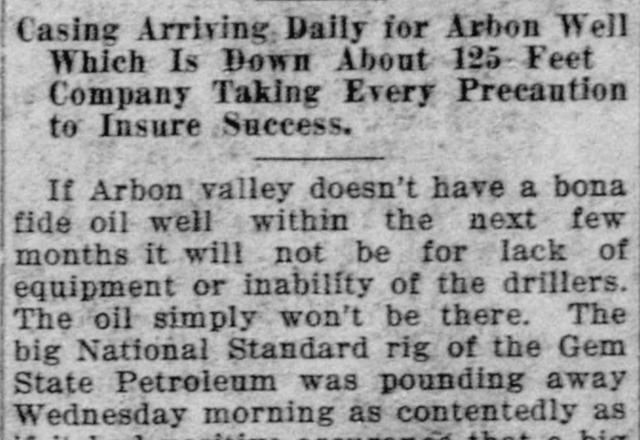
Cave-ins slowed the start. At the end of February, with the bit about 120 feet down and casing arriving daily, the Press wrote:
If Arbon valley doesn't have a bona fide oil well within the next few months it will not be for lack of equipment or inability of the drillers. The oil simply won't be there.
Arbon valley people, it added, "are watching the progress of the well with quiet suspense and are willing to let the drill decide the status of oil." Baker and Harris looked ahead to "acres and acres of tank farms, a big refinery." A full-page advertisement offered stock at 75 cents a share, invited Power and Bannock county people to come and see the rig, and declared: "IT IS A PERFECT ANTICLINAL DOME."
People came. "Miss Nellie Matthews and Miss Birdie Wacaster went down to see the oil well Sunday," the school news reported in March, and the Pauline pupils wrote: "The oil well is running now. They are about 250 feet down in the ground." Pocatello was invited for Sunday, April 27, and over 400 people came. On Wednesday, May 21, "Malad day," about 100 came with the business organizations of Malad. Friday, May 30, Decoration Day, was named American Falls day, with a fossil hunt planned on the escarpment. The Press item, which quoted the company's secretary, Baker, ended:
This will be a picnic affair and all are invited to go and requested to bring their lunch. Let us make this the big day at the big well.
No account of the day has been found. In June, Baker told Pocatello realtors the hole was a little over 900 feet deep and had cost about $14,000, not counting machinery.
Winter at the well
By late August the hole was about 1,440 feet deep. In November J. O. Noggle, who had drilled the first well at Cat Creek, Montana, took charge of the rig with a crew of five. On Friday, December 19, the valley registered 18 below. With about thirty tons of coal on hand, the crew kept drilling inside a housing the company had covered with "thick felt" and warmed with "a huge derrick stove." After a pause, work resumed on April 7, 1925, with a new crew from Wyoming.
In March 1926, at about 2,200 feet, the bit struck hard black shale, and eleven hours of drilling gained ten inches. That spring Harris wrote, in an account the Mountain Home Republican reprinted from the Burley Herald:
The well in Arbon valley has reached a depth of 2274 feet. About two weeks ago at a public inspection of the well by spectators, drillers and officers of the company were surprised by the greatest showing of oil and gas so far encountered.
The officers stopped drilling until a string of heavy casing could be hauled to the well. The Burley paper introduced Harris as "an outsider"; other reports name him as the company's president.
Deeper and slower
On September 9, 1926, receivers were appointed at Pocatello to take control of the company and its well, and that December the stockholders, about forty of whom had attended a recent meeting, were taking steps to reorganize it. In May 1927 visitors from Burley found Harris on the job and the hole at about 2,300 feet, with an open flow of natural gas; the test was expected to be finished within thirty days. Instead, late that year the crew pulled some 2,200 feet of casing and began reaming the hole. "There is gas at Arbon," a Salt Lake Tribune oil column declared in May 1928. That November the paper said the test was "said to be down around 3000 feet, the deepest well in Idaho," and added: "Drilling is very slow."
The last report found is from February 1929. After more than four years the company was still drilling, with snow "over eight feet deep" and supplies for the camp carried about eight miles of the way on sleds. The papers found do not say when drilling stopped or what became of the rig. No producing well is recorded.
On this site: the first oil well; Thomas Bowen Evans and Lorenzo Bowen "Ren" Evans; Frank Swim; and the Arbon area history.
Sources
- Salt Lake Tribune, October 13, 1922, page 18
- Salt Lake Tribune, January 18, 1923, page 14
- Salt Lake Tribune, November 18, 1923, page 60
- American Falls Press, December 6, 1923, page 1
- Salt Lake Tribune, December 19, 1923, page 18
- American Falls Press, December 20, 1923, page 2
- Salt Lake Tribune, January 10, 1924, page 12
- American Falls Press, February 28, 1924, page 1
- American Falls Press, February 28, 1924, page 8
- American Falls Press, March 6, 1924, page 4
- American Falls Press, March 27, 1924, page 2
- Salt Lake Tribune, April 30, 1924, page 18
- American Falls Press, May 22, 1924, page 1
- American Falls Press, May 22, 1924, page 4
- American Falls Press, May 29, 1924, page 1
- Pocatello Tribune, June 23, 1924, page 3
- Idaho County Free Press, August 28, 1924, page 2
- Salt Lake Tribune, November 19, 1924, page 18
- Salt Lake Tribune, November 23, 1924, page 41
- Salt Lake Tribune, December 20, 1924, page 16
- Salt Lake Tribune, December 21, 1924, page 36
- Salt Lake Tribune, April 8, 1925, page 21
- American Falls Press, October 29, 1925, page 1
- Salt Lake Tribune, March 6, 1926, page 16
- Mountain Home Republican, May 28, 1926, page 5
- Salt Lake Tribune, September 10, 1926, page 18
- Salt Lake Tribune, December 30, 1926, page 14
- Salt Lake Telegram, June 3, 1927, page 25
- Salt Lake Tribune, January 1, 1928, page 18
- Salt Lake Tribune, May 27, 1928, page 32
- Salt Lake Tribune, November 14, 1928, page 16
- Utah Statesman, February 28, 1929, page 3