In 1912 two towns competed openly for the wheat of Arbon Valley, then part of Oneida County. American Falls built a shorter road and sent its businessmen calling, the Pocatello Tribune sounded the alarm, and by December a valley farmer was in Pocatello asking for a road over Trail Creek.
The wheat went out by wagon. Early in December 1911 E. E. Zaring told the American Falls Press that forty Arbon residents had just brought about 160,000 pounds of wheat to Michaud in "a train of wagons." Michaud was a siding on the Oregon Short Line between American Falls and Pocatello, reached by the road down Bannock Creek.
A road over the Moonshine country
In the summer of 1911 the county surveyor spent about five days in the Moonshine country surveying a new road to Arbon. By that route it was 22.97 miles from American Falls to Dave Daniels's ranch, with much easier grades than an earlier road. On May 30, 1912, the Press announced a "Short Cut to Arbon": the farmers there wanted "a winter road to be used for hauling their vast yields to market," and something over $1,000 had been raised, in cash from American Falls businessmen and labor from the people of Arbon. Grading had begun under Ezra Zaring, probably the man who had reported the wheat train.
By July 18 it was finished to the Daniels place and in good condition for light travel. That was probably the ranch of Dave Daniels above the mouth of West Fork, where the 1911 survey had ended.
The Board of Trade goes visiting
With the road open, the American Falls Board of Trade planned a "Get Acquainted" trip. On Sunday morning, August 11, 1912, a party of businessmen went out to the valley, met many of the farmers that evening, and came home Monday. Among them was L. L. Evans, of an American Falls family unrelated to the Arbon Evanses. The aim, the Press said on August 15, was to know the valley's people and conditions better "and draw that trade to this city."
The visitors found the people of Arbon "very happy and prosperous" and feeling kindly toward American Falls for its road work. Pocatello had been a little longer haul, the paper explained, but the condition of the American Falls road had sent many farmers that way, and grain loaded at the siding meant an extra trip to town to trade. Now, it said, the valley was "twelve miles nearer than Pocatello."
Pocatello answers
A week later the Press reported that Pocatello would make "a last strenuous effort to again turn it their way," and planned a trip of its own. It reprinted the Pocatello Tribune of Friday, August 16, which used the valley's older name, Bannock Valley, called Pocatello the "Gate City" and American Falls the "Power City," and gave its own account of how the valley's trade had come its way:
Most of this grain during years past has been hauled to Michaud siding and the greater part of the trade has come to the Gate City instead of American Falls. This has been due to the fact that a republican board of county commissioners a few years ago spent a considerable sum of money in building a splendid road over the Mink creek divide, tapping the Rattlesnake and Bannock creek districts.
American Falls, the Tribune went on, had "awakened" and built good roads to Arbon. It added that Pocatello businessmen had recently obtained a star route, a contract mail route, between Pocatello and Crystal and Pauline. Whether mail ran on it in 1912 is doubtful; the first mail route from Pocatello records bids called for such a route that December, and 1915 complaints that Pauline and Crystal had none. The Tribune urged a Pocatello trip, by car over the divide or by the easier road up Bannock Creek, adding, "Pocatello can ill afford to lose such valuable trade." No report of that trip has been found.
An Arbon man in Pocatello
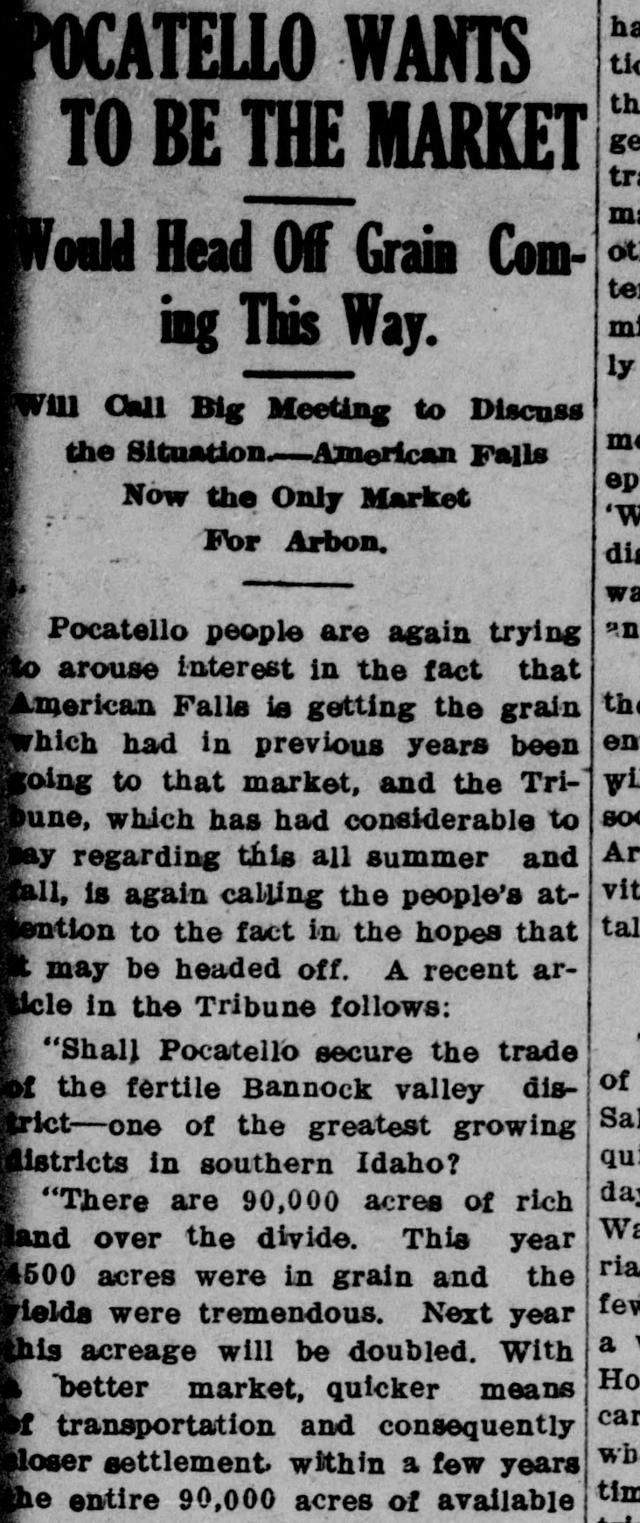
On December 26 the Press headed a front-page story "American Falls Now the Only Market For Arbon" and reprinted a recent Tribune article. L. B. Evans, vice-president of the Arbon Commercial Club, had come to Pocatello to promote a wagon road from Pocatello over Trail Creek into the valley. He was almost certainly Lorenzo "Ren" Evans of the Arbon Evans family. The club, the Tribune said, took in nearly every grain grower in the valley, and settlers on Rattlesnake Creek and at Pauline and Crystal also wanted closer ties with Pocatello. Malad, the valley's other market, had arranged to spend $2,500 on a road over a high divide from Arbon. Bannock County's commissioners had promised the Trail Creek road but instead appropriated $500 for bridges and repairs on the Michaud Creek road, which diverted business to American Falls.
Evans said six weeks of hauling down the valley to Michaud and on to American Falls had been "record breaking," with thirty-six teams on the road. A Trail Creek road would cost $2,000, he said. He and his neighbors preferred Pocatello as a market for banking, shipping and other reasons, but it was up to Pocatello to act. He also brought an offer:
Mr. Evans says the Arbon Commercial club is also anxious for telephone connections with Pocatello. 'We will furnish the poles free and distribute them along the right-of-way if others will furnish the wire and do the construction work.'
W. H. Bohlschied, president of the Pocatello Commercial Club, was to call a meeting with the Arbon club. No report of it has been found.
What came of it
Early in 1913 the new Power County took in Arbon, Pauline and Crystal, with its seat, at first temporarily, at American Falls. In March W. E. Dawson wrote for the Arbon Commercial Club that it was building a telephone line and looked for "good substantial aid from you our 'Power Center.'" In September, after what the Press called "a long, hard pull" by the Board of Trade, valley people organized a telephone company on the terms Mountain States had set for building a toll line to them from American Falls, and the paper expected the line to be built that fall. It did not join the valley's own line until early December 1915.
The Trail Creek road waited. In October 1916 the Salt Lake Tribune reported that the Pocatello Commercial Club had named a committee to look into a wagon road of about forty miles over the Trail Creek route; an earlier survey had been set aside while a railroad seemed likely. Lorenzo Evans's family remembered him working hard for a good road over Mink Creek so people could shop in Pocatello.
On this site: Pauline and West Fork, Crystal and the first engineered road out of the valley.
Sources
- American Falls Press, July 6, 1911, page 1
- American Falls Press, December 7, 1911, page 1
- American Falls Press, May 30, 1912, page 1
- American Falls Press, July 18, 1912, page 6
- American Falls Press, August 15, 1912, page 1
- American Falls Press, August 22, 1912, page 1
- American Falls Press, December 26, 1912, page 1
- American Falls Press, February 6, 1913, page 1
- American Falls Press, March 20, 1913, page 7
- American Falls Press, September 11, 1913, page 1
- Salt Lake Tribune, October 1, 1916, page 14