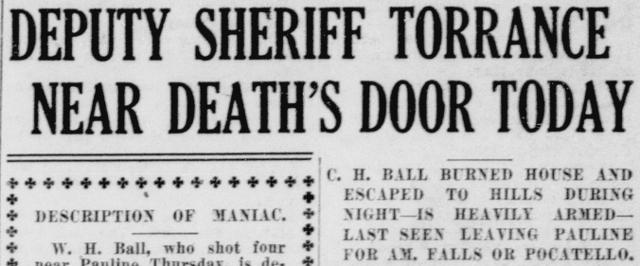
On St. Patrick's Day, March 17, 1921, W. H. Ball, a farmer near Pauline at the north end of Arbon Valley, shot his neighbor Ed Brandt on the road. Late that afternoon he fired on a posse at his cabin and mortally wounded Deputy Sheriff Charles H. Torrance of American Falls. By the end of the year two Power County juries had found him not guilty.
The road and the cabin
According to the Press, Ball quarreled that Thursday morning with Dick Steed at the Davis store in Pauline. A mile out of town he met Brandt driving his team in. As Brandt told it to Deputy Sheriff Hyrum Secrist, Ball drew a pistol and fired twice, hitting him in the forearm, and drove home.
Deputy Torrance came out from American Falls, deputized John Kowallis, Herbert Swim and Eric Young at Pauline, and went with them and Secrist to Ball's place. At the trial they testified that they watched the place for two hours and moved in while Ball was out with his gun. When he came back, about half past five, he was ordered to put up his hands. They said he opened fire. A shot took the cap from Secrist's head. Kowallis was hit in the arm, Swim's leg was broken, and Torrance was struck by buckshot at close range. Ball burned his house, the Press said, and got away into the hills. The next morning's Press reported:
Arbon Valley is in arms. Every male citizen has shouldered a gun and is searching the hills for the mad man who escaped under cover of darkness. Pocatello and American Falls police forces are uniting in the search. Every crossroad has been picketed.
Ball, shot in the arm, reached the ranch of J. E. Pauling (Polling in the Press), who, the Ogden Standard-Examiner said, took him over the divide in a wagon. The Press said only that at three in the morning two boys brought him into St. Anthony's hospital in Pocatello and left before the authorities could learn their names. The arm was amputated. Bannock County officers who talked with him, the Standard-Examiner added, did not think him insane.
Torrance died at the Bethany Deaconess hospital in American Falls on Sunday, March 20. Born in Oregon in 1867, he had lived in American Falls since 1908 and taught a large Sunday school class of boys at the Baptist church. More than 600 people came to his funeral in the Auditorium, where Rev. A. J. Ford called him "a martyr to duty."
The murder trial
Ball was charged with first-degree murder and three assaults, and Brandt sued him for $20,000. The trial opened on June 20 at American Falls before Judge Ralph W. Adair of Blackfoot, in a crowded courtroom.
Secrist testified that he told Ball he was under arrest, and Kowallis that Torrance told Ball he was an officer. Ball's lawyers showed that at the preliminary hearing neither man had said Ball was told officers had come to arrest him. Two defense witnesses spoke of a mob of fifteen men or so besides the posse, until one of them, Verne Munn, put those men more than two miles away at the Pauline store. Here, the Press wrote, "a small bomb burst in the defense testimony."
In the Press's words, Ball "told a simple and colorless story." He had gone hunting on the reservation, he said, though he expected an officer to come for him. Ordered to halt, he set the butt of his gun on the ground and asked whether there were officers in the crowd. He "was answered by a shot," he said, and then he began firing. His plea was self-defense: seeing Eric Young, Brandt's brother-in-law, among them, he had fired believing "it was a mob come to take his life." After deliberating overnight, on the morning of June 24, the jury found him not guilty. Ball was at once arrested again for shooting Brandt.
Four prospective jurors had told Ball's lawyer, Judge J. M. Stevens, that they believed nothing they read in newspapers. In the issue that reported the verdict the Press explained that its first story was phoned in from Pauline two hours after the shooting, when "the people were excited." It added:
The Press carried the story in detail, forty eight hours after the shooting occurred and was still not in accord with the exact facts in the case. Indeed a story of the true facts will probably never be written. Human intelligence and human senses are not dependable under conditions of excitement. An eye witness to a tragedy may be the most inaccurate in his report of what occurred.
The Brandt trials
Ball's trial for assault with intent to murder Brandt opened on October 6. On the second day, after Brandt and two eyewitnesses had testified, Judge O. R. Baum threw it out: the charge filed by Prosecuting Attorney C. T. Cotant did not state a crime against the state.
The second trial began on December 19. According to the Salt Lake Telegram, Fred Bishoff and Kenneth Waylett of Pauline testified that Ball passed Brandt on the road, tied his team about a hundred yards on, walked back and fired twice. Ball testified that when Brandt called to him he looked back, saw a rifle pointed at him, and walked back and shot Brandt in the arm. In the Press's report of his testimony, Brandt "drew a rifle on him but did not fire a shot." The defense attacked the eyewitnesses' testimony on the ground that they had been excited. At eleven o'clock on the night of December 20, after three and a half hours, the jury found Ball not guilty. The Press wrote that "a carefully planned theoretical plea of self defense" had overcome "the strongest direct convincing evidence heard in a recent criminal case in Power County."
Afterward
In May 1922 the state industrial accident board denied Kowallis's claim for compensation as a man the law had obliged to serve as a deputy. The papers searched do not say how Brandt's suit ended or what became of Ball.
Accounts differ. Melinda Campbell's much later history of Pauline and West Fork says Brandt fired first on the road, one of the men gathered around the cabin shot Ball before he fired, and the posse burned the cabin. None of the 1921 papers read for this post reports Brandt firing, and the Press said Ball burned his own house; only Ball's own testimony that he "was answered by a shot" agrees with her in part.
On this site: The St. Patrick's Day shootings near Pauline, Two juries acquit W. H. Ball, Valley Tragedies and the Swim family.
Sources
- American Falls Press, March 18, 1921, page 1
- American Falls Press, March 18, 1921, page 8
- Ogden Standard-Examiner, March 19, 1921, page 4
- American Falls Press, March 25, 1921, page 1
- American Falls Press, March 25, 1921, page 8
- American Falls Press, June 10, 1921, page 1
- American Falls Press, June 24, 1921, page 1
- American Falls Press, June 24, 1921, page 4
- American Falls Press, June 24, 1921, page 8
- American Falls Press, October 14, 1921, page 1
- Salt Lake Telegram, December 21, 1921, page 2
- American Falls Press, December 23, 1921, page 1
- Deseret News, May 31, 1922, page 18
- Melinda Campbell, Pauline and West Fork, on ArbonValley.com