In the fall of 1920 the snow came to Arbon Valley before the harvest was in. From late October until the following May, the Arbon correspondent of the American Falls Press followed the season week by week, from stranded grain and drifted roads to families gone to town and a spring that kept turning back to snow.
Arbon, in Oneida County until 1913, was now in Power County. Its wheat went out by wagon or truck to the railroad at Michaud, north of the valley.
Snow before the threshing was done
On October 22, 1920, the Press reported "unprecedented early snows" of six inches and more across the county, injuring unthreshed grain. On election day, November 2, more than a foot of snow lay on the county. Only 72 of Arbon's 117 registered voters came to the polls; several had moved out for the winter, and bad roads kept others home.
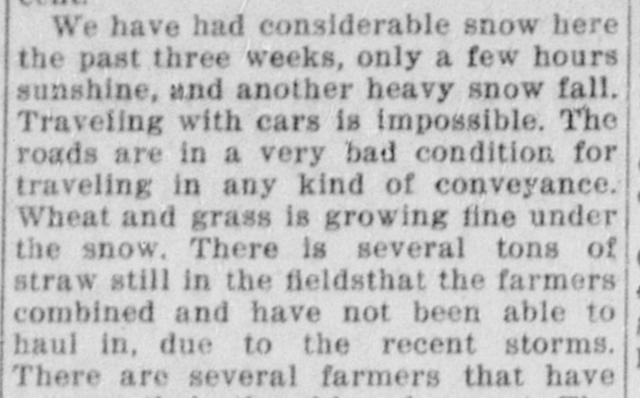
The Arbon column of November 12 described three weeks of snow with only a few hours of sunshine, and then another heavy fall: "Traveling with cars is impossible." Wheat and grass were growing under the snow. Several tons of grain cut by combine had not been hauled in, some farmers still had straw in the fields and their threshing unfinished, and "the threshers are running whenever the weather will permit."
Thanksgiving to Christmas
Thanksgiving Day dawned bright and sunny, the column of December 3 said. After a break in the scanned text, it reports "a raging blizzard, with sleet and rain lasting for several hours, followed by freezing weather." That evening Mr. and Mrs. Clive Hatfield had friends in, and "Carpets were taken up and the good old dances as well as new were indulged in."
The freeze helped in one way. With the roads frozen, the grain trucks were hauling to Michaud again, sleighs were out, and the mail carrier, probably Marsdon Tallon, got the mail through "due to the good roads." But much grain was still not threshed: "The steam thresher works when the weather permits, which is not very often these days."
A week later, on December 10:
Another blizzard Friday covered everything with snow again, drifting the roads full. The storm was followed by freezing weather.
The Burnside Brothers of Pocatello were in Arbon "with their large trucks hauling the Association Grain," probably the grain of the Wheat Growers Association. The column of December 17 reported that E. O. Lee had gone to Pocatello for repairs to the threshing outfit: "Threshing is delayed again due to the recent bad weather." The papers do not say when the threshing was finished.
Wintering out
Meanwhile families were leaving, as valley families had done since the first years. The Jesse Secrists went to Pocatello for the winter, and so did the Lorin Baileys and an Evans family whose initials are garbled in the scanned text, probably Joe Evans, son of T. B. Evans, who came from Pocatello to visit his parents in March. On December 10 the column reported that Joseph N. Arbon and family had moved to Malad for the winter, and that Mr. and Mrs. Melvin Bailey had moved onto the Arbon farm. The Misses Mary and Elizabeth Bailey went to Pocatello to stay indefinitely.
At Christmas J. N. Arbon visited Malad, where Mrs. Arbon and the children were, and his father, "Grandpa Arbon." May Davis remembered a Christmas Eve party at the Joe Arbons' that turned into a night snowed in, and dated it 1920. The site's Stories entry puts it probably in another year, and the family's winter move to Malad supports that.
Those who stayed made their own evenings. Early in the winter the Central school's basket social for the pupils' hot lunches was poorly attended "due to bad weather and roads," though it raised $20. In January there was a well-attended dance at Pauline, and the Melvin Baileys had a large crowd in for dancing. About thirty-five friends walked in on Mr. and Mrs. William Allard one Saturday evening for a surprise party, where the refreshments "were served in the form of a bill of fare, each guest guessing what each number represented."
Thaw, and snow again
On January 21, 1921, the column wrote:
We have been having some thawing winds the past week, fields are beginning to look black, altho we still have plenty of snow. Everyone says they have more snow and larger drifts than the winter four years ago.
Four years earlier was the winter of 1916–17, when hay ran short and stock died in the hills. Two days of thaw, with wind and rain, sent water into several basements and cellars; then three sunny days and moonlit nights made the Arbonites feel they were in "a country where the wind never blows." In February the county Farm Bureau said it would organize Arbon, Crystal and Pauline "as soon as the roads permit."
The breakup came in March:
The snow has been going very fast the past week. Roads are in very bad shape, no sleighing to speak of, and in fact no roads for other vehicles.
The hot lunches at the Arbon school were "dispensed with since the warm weather began." Then the families came home. Mary Bailey returned from Pocatello, and Marsdon Tallon (printed Talion) came out to his farm, having given the Pocatello–Arbon mail route to Oliver Foutz. Mrs. Jack Price and her children came back to West Fork from Malad. By March 18 the Melvin Baileys were back on their own farm near Central Arbon. The column of April 8 reported that Mrs. Joe Arbon and her little son Harold had come out from Malad. George Arbon, "Grandpa" Arbon, for whom the valley was named, had died in March, and his funeral was held at Malad.
Spring was not done with snow. On April 22 the column reported another heavy storm, which covered the grass: "This spring has been very hard on range stock which was put out at the regular time in the spring." By May 6 the storms had blown over, and the trucks were "moving out the balance of the Wheat Growers Association grain to Michaud." In the week before May 27 there was good rain nearly every day, and the shareholders of the Knox Canyon water, which had fed the valley's first ditch, were irrigating their alfalfa with "more water than the ditch will hold." What the winter cost in grain, the columns do not say.
On this site: Arbon, Pauline and West Fork, the Arbon family and the first trucks.
Sources
- American Falls Press, October 22, 1920, page 1
- American Falls Press, November 5, 1920, page 1
- American Falls Press, November 12, 1920, page 2
- American Falls Press, December 3, 1920, page 2
- American Falls Press, December 10, 1920, page 7
- American Falls Press, December 17, 1920, page 4
- American Falls Press, January 7, 1921, page 2
- American Falls Press, January 21, 1921, page 2
- American Falls Press, February 4, 1921, page 2
- American Falls Press, February 18, 1921, page 4
- American Falls Press, March 11, 1921, page 2
- American Falls Press, March 18, 1921, page 2
- American Falls Press, March 25, 1921, page 2
- American Falls Press, April 8, 1921, page 2
- American Falls Press, April 22, 1921, page 2
- American Falls Press, May 6, 1921, page 2
- American Falls Press, May 27, 1921, page 2