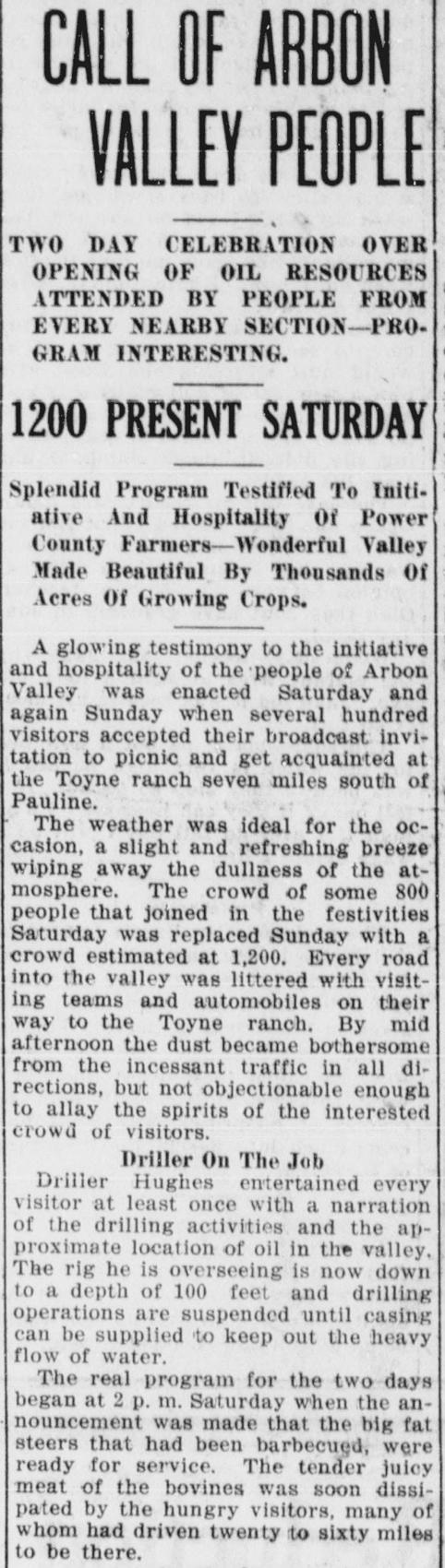
In June 1921 a Pocatello company began drilling Arbon Valley's first oil test on Thomas S. Toyn's ranch, about six miles south of the Pauline store, and on June 25 and 26 the valley invited its neighbors to celebrate at the well. The American Falls Press, the Power County seat's weekly, followed the well for sixteen months, usually spelling the family's name Toyne.
A company from Pocatello
The Idaho Research and Development Co., with headquarters at Pocatello, filed its articles of incorporation in June 1920 with a capital stock of $1,000,000. George Stoll Sr., a Pocatello accountant, had raised money for a survey that, by the company's account, traced oil seeps west to a "dome" under Arbon Valley. Among the first subscribers was Lorenzo B. Evans of Arbon, the early settler Ren Evans.
"There is some talk here about drilling for oil," the Arbon column reported on May 6, 1921. "Most of the Arbonites think seeing is believing." In the same column Stoll was the guest of Mr. and Mrs. Toyn, who had probably bought the former Ripley ranch in 1920. By June the company held over 35,000 acres of leases and had raised enough money to buy machinery to drill to 3,600 feet. Its derrick went up on the Toyn ranch, said to sit on the dome, and by Sunday, June 12, Charles Hughes, an Oklahoma oil man, was drilling the first oil well in that territory.
Two days at the Toyn ranch
The Press announced that barbecue, ball games, horse races, dancing, fireworks, chicken dinners and an automobile excursion would "usher the oil industry into Arbon Valley and incidentally entertain the people of American Falls, Pocatello, Rockland, Holbrook, Malad and a score of other towns." Food and sleeping quarters were free, though visitors were asked to bring their own bedding. The paper urged everyone to go, though its editorial doubted the well:
We are naturally skeptical about the finding of oil on the Toyne Ranch near Pauline. The probabilities are that a dry hole will result from the drilling. But there is the big chance, the one worth taking, that there is oil buried several thousand feet below the crust of the earth. A few thousand dollars may be invested in a dry hole. Then again a great oil district may be opened to the world, bringing with it untold wealth, overnight fortunes, industrial developement, and progress.
The celebration, it added, was no stock-selling scheme, only a sign that the valley's people were "awake to their possibilities."
About 800 people came on Saturday and about 1,200 on Sunday, many of them driving "twenty to sixty miles to be there." Hughes "entertained every visitor at least once with a narration of the drilling activities and the proximate location of oil in the valley." The well was 100 feet down, and drilling had stopped until casing, the steel pipe that lines a well, could be supplied to shut off a heavy flow of water.
Saturday brought barbecued steers. Pauline, the Arbon Bears and a Daniels team played ball, and Senator Harding of Malad "told graphically of the early pioneer days when the first settlers had come to the valley." On Sunday the valley's women served a chicken dinner, the visitors toured the valley, and American Falls beat the Arbon Bears 21 to 6. Early in the week sixty men had built a dance floor and a shelter, apparently roofed with wild hay. An editorial praised the women of Arbon, Pauline and Crystal for feeding the crowds and allowed that "Oil may not be found at the Toyne ranch in Arbon."
Pockets, shows and promises
By November Z. D. Terry of Fort Worth, Texas, was in charge of the drilling, and the accounts began to differ. A Pocatello report in the Salt Lake Tribune said that the oil struck in the well had proved merely a pocket, the second the drill had met (the damaged print mentions one at 207 feet); it flowed for a day and gave out. The Press, on the company's account, said a flow of several barrels on November 10 had been cased off so the drill could go on to 2,000 feet, "where the company expects to hit a gusher perhaps." The company's more than 150 stockholders were "mostly Pocatello and Arbon citizens," and Evans was its vice president.
Around the turn of the year Evans was out selling stock. In January 1922 he claimed a showing of crude oil at 245 feet, coming up with a strong flow of water. Ranchers who had leased their land had "flattering offers to sell their leases to outside parties," and the Press predicted that if Arbon struck oil, "the entire county will be drilled out." Thirty-four men of American Falls and Rockland, he announced, had subscribed for stock in what the paper now called "the Arbon Oil Company." The paper did not explain the name.
In March the company spoke of "test wells in every part of the valley" and a refinery once the first well came in. In July a Press article claimed the well had passed through three layers of oil and that an oil expert "of Pittsburg" put the main oil zone at about 12,000 feet. The writer foresaw "one of the biggest booms known to oil in recent years."
The geologist's verdict
That summer the state bureau of mines and geology sent its petroleum geologist, Virgil R. D. Kirkham, to the Arbon and Rockland valleys. His October report found rocks of an age favorable to oil and "a good anticline dome structure," an upward arch in the rock layers, outlined by the valley walls, but much faulting nearby. It went on:
There are in the state areas of greater promise, but there are possibilities in Arbon valley. This region is being tested by a well belonging to the Idaho Research and Development company of Pocatello. As yet they have not passed through the covering of volcanic and lake bed material and can expect no results until after penetrating the under-lying carboniferous limestone.
The papers searched carry no later report of the Toyn ranch well, its final depth or its end. The company was later named, without explanation, among the defendants in two foreclosure suits, on Jenks land near Pauline in 1923 and on the Toyn ranch in 1925. In December 1923 a second company, the Gem State Petroleum Co., with L. B. Evans among its backers, unloaded a 75-ton rig at Pocatello for another test in Arbon Valley.
On this site: the first oil well, the foreclosures of 1920–1925, the Evans family, and the Pauline and West Fork area history.
Sources
- American Falls Press, May 6, 1921, page 2
- American Falls Press, June 3, 1921, page 1
- American Falls Press, June 17, 1921, page 1
- American Falls Press, June 24, 1921, page 1
- American Falls Press, June 24, 1921, page 6
- American Falls Press, July 1, 1921, page 1
- American Falls Press, July 1, 1921, page 6
- American Falls Press, November 11, 1921, page 4
- American Falls Press, December 16, 1921, page 14
- American Falls Press, January 6, 1922, page 1
- American Falls Press, January 27, 1922, page 1
- American Falls Press, March 24, 1922, page 4
- American Falls Press, July 13, 1922, page 5
- American Falls Press, October 19, 1922, page 1
- American Falls Press, September 20, 1923, page 7
- American Falls Press, December 6, 1923, page 1
- American Falls Press, August 6, 1925, page 3
- Salt Lake Tribune, June 20, 1920, page 4
- Salt Lake Tribune, November 18, 1921, page 18