In the spring of 1915 the Arbon correspondent of the American Falls Press judged from the logs at John Payne's sawmill that it would be a building year. Arbon had been in Oneida County until 1913 and was now in Power County. Through the rest of that year the paper's Arbon and South Arbon columns followed the valley's canyon sawmills, and the houses that went up, a line or two at a time.
Logs at Payne's mill
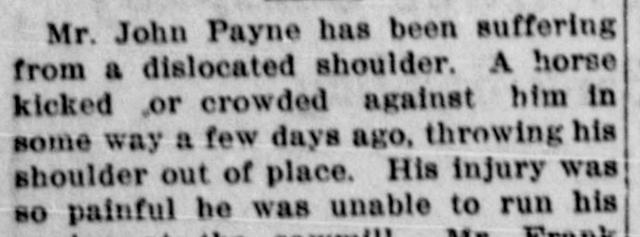
John Payne, an English-born railroad man, was one of Arbon's early settlers and kept a store with his wife Emily. On April 29, 1915, the column reported that he had dislocated his shoulder a few days before and could not run his engine at the sawmill. A Frank Jones took charge for a few days. The correspondent added:
From the appearance of the large quantity of logs at the mill there will be a considerable amount of building this year in Arbon.
Some building had already begun. The same column reported Melvin Bailey's wedding and said the couple would live on his homestead, where he had "recently built a fine dwelling" (the Bailey family). Two weeks later Payne himself was building "a fine dwelling in Knox canyon, where his saw mill is located." Knox Canyon's stream had watered the valley's first ditch. In May the right-hand road in the canyon was repaired, with new bridges, for those who wanted to log, and in June new homesteaders were building on claims they had just filed there. "Even the mountain ranges are being homesteaded," the Central Arbon column said, "which is gradually crowding out the sheepmen."
Mills changed hands too. On May 6 the column reported only that "Mr. Walker" had sold his sawmill to "Mr. Calhoun," with no first names and no location.
Nunnelley's mill in Bull Canyon
At the Summit end, W. A. Nunnelley, a Kentucky sawmill man, ran a mill in Bull Canyon. On June 3 the South Arbon column said he was repairing it and meant to start sawing in a few days. Two men, probably Ed Hooker and Gus Brahmstadt (the scan garbles both names), were logging in the canyon and "are going to get their building done before the rush at harvest time."
Rain slowed the work. On June 17 the column said Nunnelley "has had to close his saw mill for a few days on account of heavy rains in the mountains," and the loggers were waiting for the roads to dry. In mid-July George Bollinger, W. H. Smith and several neighbors were in the canyon getting out logs.
The same July column reported an accident at the mill. Alvin Jensen, who did not work there, "just stepped on the carriage and had his hand on the headblock as the carriage came back." The sawyer, Mr. Angle, did not see him in time to stop the engine, and all four fingers of Jensen's right hand were badly cut. In August Nunnelley went to Malad for a new belt for his mill.
On September 2 the column, which called the past ten days the hottest in that part of the country since its settlement six years before, told of a fire:
Some one put out a fire on the flat above Nunnelley's saw-mill, last Tuesday afternoon after it had done considerable damage. It soon spread and got into the timber in several of the branch canyons where it burned until sometime during the night.
The wording leaves unclear whether someone set the fire or put it out.
Houses all season
The Press's county "Building News" of July 8 listed William Allard, who sat for Power County in the Idaho House that year, building a five-room house on his ranch at Arbon. On August 12 Allard, P. A. Hartley, E. E. England, J. P. Kelly and A. Hatfield of Arbon were hauling house bills, that is, the lumber ordered for a house, from the Idaho Lumber company yard at American Falls. Not all the valley's lumber came from its own canyons. In September E. Hatley of Arbon was building a house on his ranch, and at South Arbon Roy Smith was putting up a bungalow on his homestead.
One builder had already proved up, that is, lived on and farmed his claim for the required years and made final proof for his title. On September 16 the column reported:
Mr. George Bollinger is erecting a house on the homestead belonging to his wife and they intend to make that their home Mr. Bollinger having proved up on his homestead some time ago.
His wife, Sarah, died at Pocatello the next year; her story is among the Stories.
At the south end, Mr. McIntyre, the contractor building the Highland school on Mamie Nunnelley's land, found help so hard to get in the busy season that he brought men from Malad Valley.
By the start of December T. B. Evans had moved his family into their new home west of the Central school. At about the same time the valley's line was connected by telephone with American Falls, and a telephone man from Pocatello moved the switchboard into the Evans house (the first long-distance call). Two years later the Press described it as a modern four-room frame dwelling on a concrete foundation. Before it the family had lived for sixteen years in "a cabin of sawed logs."
After the season
Nunnelley also ran a threshing crew that fall. In early October Robert Angle, who had been running the mill, took Nunnelley's "big engine" back to Bull Canyon. On November 11 the column reported that "W. A. Nunnelly has started his saw mill again and will saw as long as the weather permits," and that Emmett Lee and Bob Stott had been logging that week.
In the spring of 1916 the Bull Canyon mill burned, with about 16,000 feet of lumber (the Nunnelley mill fire). In June 1916 the Arbon column reported that "Jack Payne moved his engine up to his sawmill and will soon commence sawing." This was probably John Payne, who was also known as Jack. In March 1917 Mrs. E. A. Logan's history of the valley reported that "Two saw mills are doing good business," and wrote of "John Payne, an old engineer," who owned "a good farm and a good saw mill in Knox canyon." She credited William A. Nunnelley and others whose names the scan scrambles (apparently David Ripley and the Dawson brothers) with making it possible for the valley's farmers "to erect many new buildings."
On this site: the first sawmill, which lists the valley's later mills, and the Summit and Arbon area histories.
Sources
- American Falls Press, April 29, 1915, page 4
- American Falls Press, May 6, 1915, page 4
- American Falls Press, May 13, 1915, page 8
- American Falls Press, May 20, 1915, page 8
- American Falls Press, June 3, 1915, page 4
- American Falls Press, June 17, 1915, page 1
- American Falls Press, July 8, 1915, page 1
- American Falls Press, July 15, 1915, page 1
- American Falls Press, August 12, 1915, page 4
- American Falls Press, August 12, 1915, page 5
- American Falls Press, September 2, 1915, page 1
- American Falls Press, September 2, 1915, page 8
- American Falls Press, September 16, 1915, page 2
- American Falls Press, October 14, 1915, page 6
- American Falls Press, November 11, 1915, page 5
- American Falls Press, December 2, 1915, page 3
- American Falls Press, December 9, 1915, page 1
- American Falls Press, June 1, 1916, page 1
- American Falls Press, June 22, 1916, page 8
- American Falls Press, March 29, 1917, page 7
- American Falls Press, December 14, 1917, page 3