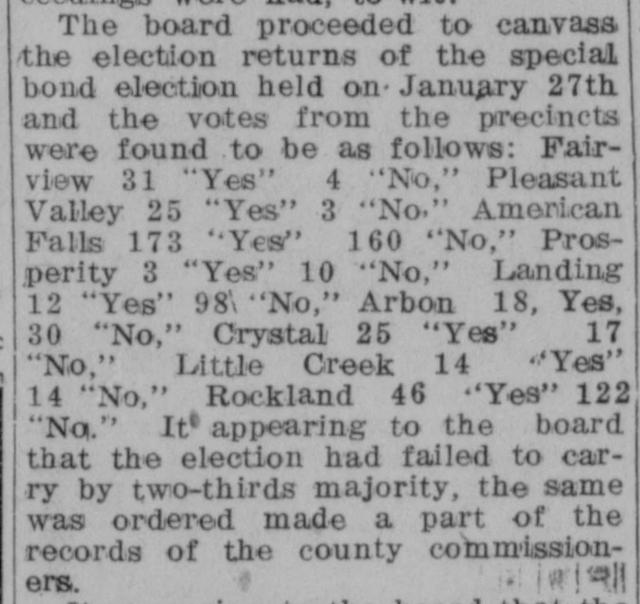
On January 27, 1914, the voters of the new Power County decided whether the county should borrow $125,000 for roads and bridges. One of the roads on offer was to run from Arbon to the state road. Arbon precinct answered 130 to 18 against.
Power County had been created in 1913 from parts of four counties; until then Arbon had been a precinct of Oneida County, governed from Malad. On December 9, 1913, the county commissioners called the special election. Arbon was to vote at schoolhouse No. 12, with William E. Dawson and T. B. Evans as judges and William Allard as clerk, and Crystal at schoolhouse No. 14. To carry, the bonds needed a two-thirds majority.
A rumor and a promise
The American Falls Press was for the bonds. On December 18 it warned that "opposition from the very people who are to be most benefitted comes as somewhat of a surprise," and pointed to rumors, one of which, it said, seemed to have carried to the farthest corners of the county:
It is stated that the purpose of the commissioners is to build a system of good automobile roads within a radius of ten or fifteen miles of American Falls and that those sections farther out are to be left without improvement.
The paper called this "probably the farthest from the truth" and said the roads would reach every part of the county, with spurs into the outlying districts.
On January 15 the commissioners, Andrew May, W. S. Sparks and A. Winter, published "A Straightforward Statement." They promised six trunk roads, about 80 miles in all, with no grade steeper than four per cent. One of the six was for the valley:
Another trunk line from a point to be selected by said engineer, at or near the John Paine place in Arbon to an intersection with the State road leading from American Falls to Pocatello, and along a route selected by said engineer.
The Paine place was probably the land of John Payne, George Arbon's son-in-law, in Section 23 at the heart of the Arbon floor. The length given for the Arbon road is garbled in the digitized text. The commissioners figured the roads at $800 a mile, on the estimate of Ed Smith, engineer for the state highway commission, and said they would sell only $75,000 of the bonds at first.
What it would cost Joseph Arbon
The same issue carried "Facts and Figures for the Voters." The Press took taxpayers from the assessment rolls, from Rockland to American Falls, and worked out what each would pay toward the interest. One lived in the valley:
The next man is away up in Arbon. Mr. Joseph Arbon. His valuation is $4,920, and his taxes as follows: ... A special tax of some kind brings his total tax to $69.72. If the bonds carry he will next year pay $5.41 more. Will good roads be worth that much to him.
He was almost certainly Joseph Nicholas Arbon, who with his father George is remembered as the first to stay through a valley winter. These figures added the interest on top of present taxes. The Press explained that the commissioners meant to pay it out of the existing road levy, which would "not increase the taxes at all." Of the valley the paper wrote: "And Arbon? Its growth has been like the other sections almost too great to be comprehended."
The vote
Shortly before the election, Sheriff Jeffries and Billy Wall made a Sunday trip to Bannock Valley, as the Press still called the valley, and Wall delivered the bond-election ballots to the Arbon and Crystal precincts.
Two days after the vote the Press reported "a hopeless defeat." The bonds had not won even a simple majority in the precincts heard from, and American Falls had carried them by only thirteen votes. A week later Landing was in, 12 for and 98 against, and Crystal, 25 for and 17 against. Of the valley's main precinct the paper could say only: "Figures on the vote at Arbon were not obtainable but it is understood to be against the bonds."
When the commissioners canvassed the returns early in February, Arbon stood at 18 for and 130 against. Only American Falls and Rockland cast more votes than Arbon's 148, and only American Falls cast more "no" votes. Across the county the canvass figures add up to 347 for and 558 against. The board found that the bonds had failed to carry by two-thirds.
No report found in the Press says why Arbon voted as it did, and no letter from the valley explaining the vote has been found. Crystal, the other valley precinct in the county, gave the bonds a majority, though not two-thirds.
After the vote
The Press had predicted a highway district instead. In April a petition asked for one covering the county west of the Snake River and the land east of it along the state highway; as described, it probably would not have taken in the valley. An election was set for June 9, and by late July the commissioners' minutes referred to a highway district created out of part of the county.
The valley's roads stayed with the county and its local overseers. Two weeks before the vote the commissioners had granted the petition of W. F. Kowallis (probably the Meadow Ward bishop at Pauline) and others to make W. E. Dawson road overseer for the Arbon district. In April the board put off a petition of Mrs. D. B. Evans, as the text appears to read, until it could visit Arbon precinct, and in July it paid her damages on account of a county road. She was probably Hannah Evans, widowed when David Bowen Evans died on December 30, 1913. The July bills also paid H. Boyd for a trip over the Arbon road with Sparks and Evans, and paid Joseph N. Arbon, among many others, for road work.
The valley got a highway district of its own in 1918. After a special election on June 12, the commissioners declared a territory taking in Arbon and Pauline "created and established into Highway District No. 3." Later that year a special election in the Arbon and Pauline precincts of the district voted on issuing $50,000 in bonds. The commissioners' minutes of November 8, 1918, give only Pauline's count, 56 for and 10 against, and record that the bond issue carried. In 1919 a state highway from Pocatello to Arbon was designated and the district sought bids to gravel the Bannock Creek road, as the first state highway and graveled road tells.
On this site: the first engineered road out of the valley tells of the roads before 1914, and the Arbon area history of the settlement itself.
Sources
- American Falls Press, December 18, 1913, page 1
- American Falls Press, January 1, 1914, page 5
- American Falls Press, January 15, 1914, page 1
- American Falls Press, January 15, 1914, page 4
- American Falls Press, January 22, 1914, page 2
- American Falls Press, January 22, 1914, page 7
- American Falls Press, January 29, 1914, page 1
- American Falls Press, February 5, 1914, page 5
- American Falls Press, February 5, 1914, page 7
- American Falls Press, February 26, 1914, page 5
- American Falls Press, April 23, 1914, page 2
- American Falls Press, April 30, 1914, page 1
- American Falls Press, May 14, 1914, page 12
- American Falls Press, July 30, 1914, page 2
- American Falls Press, August 6, 1914, page 3
- American Falls Press, June 25, 1918, page 3
- American Falls Press, November 15, 1918, page 3