In 1922 the dry farmers of Arbon Valley, south of American Falls and Pocatello, who grew their wheat without irrigation, brought in a harvest slowed by rain and weeds. The American Falls Press, published at the seat of Power County (the valley had been in Oneida County until 1913), followed it in its Arbon, South Arbon and Pauline columns.
A spotty start
Some of the wheat sown the fall before had not survived the winter. On May 25 the Arbon Items reported, "Fall grain that is up and did not winter kill is looking good, but fields are very spotted." Hard rains that week helped, and more heavy rains in late June "came in the niche of time," the column wrote on June 29, though hail did a little damage in places and pigweed and other weeds were smothering some of the wheat.
On July 13 the Press reported a prediction of sixty to seventy-five percent of a normal yield for the county. Many in the Rockland and Arbon valleys expected a heavier crop than the year before, despite pessimistic reports of grasshoppers, winter kill and squirrels, and Arbon Valley was reported better than Rockland across the mountains. A late freeze had done considerable damage the year before. "This has not occured thus far this year," the paper wrote, "and it is probable that the 1922 yield at Arbon Crystal and Pauline will exceed that of 1921."
In August the Chamber of Commerce's promotional column said an average yield of twenty bushels to the acre was generally predicted, and that the grasshoppers bred in the dry fall of 1921 had mostly been destroyed by prompt poisoning. The county agent, Morrell, reported that 7,000 pounds of white arsenic had gone into the county's poison bait that season.
Harvest in the rain
Harvest at the south end of the valley came in a spell of wet weather. The South Arbon column of August 17 reported:
The hard rains of the past week which were every day, has delayed harvest considerable. The weeds are growing fast above the grain since the rains, which will make harvesting difficult.
Mr. Hill completed harvesting 80 acres with his new combine, Saturday, which averaged 23 bushels per acre.
Mr. Hill was probably T. H. Hill, whom the same column named secretary-treasurer of the telephone company. The site's Stories count T. H. Hill among the four neighbors who bought one of the valley's first combines together in 1915. A combine cut and threshed the grain in one pass.
Other farmers still cut with headers, which clipped the heads from the standing grain to be threshed by a separate machine. On August 24 the Arbon column described one such outfit at work:
J. P. Sorenson started heading and threshing last Thursday. He has two headers running to supply grain for the threshing machine. A fine crew of men to help and Mrs. Mock has charge of the cook wagon, which insures good meals and the result will be success.
J. P. Sorenson was probably James Parley Sorensen, one of the Summit homesteaders. The same column reported that Joe C. Jensen and A. A. Sorenson had each lost a horse to poison weeds, and that three days of very hard rain and electrical storms had delayed the harvesting again. The front page that week reported weeds "green and of enormous size" in parts of the county, and "Hail has caused some damage to crops in the Arbon Valley."
Hands and hauling
Some help came from family. William Affleck and his son Clarke came from Logan, Utah, to William's son Orville, and went home when Orville's harvest was done. Across the county, the farm bureau had found work for seventy-five harvest hands by mid-August, at no more than $2.50 a day.
Men from town were another matter. The valley's mail came out from Pocatello by way of Crystal and Pauline on a star route, a mail route let by contract, and since July the carrier had been Theo Daniels of Pauline; one week in August his brother Bert carried it for him. On August 31 the Arbon column reported:
Theo. Daniels the star route carrier is busy these days carrying men to and fro who come out inquiring for work. But by the time the mail goes next day they have cold feet, and go back to town.
By then the wheat was moving. C. D. Porter and his son Orville came out from Pocatello to freight out their grain. On September 28 the Pauline column reported harvest nearly done and many farmers sowing for the next year. "A great deal of wheat is being hauled in to the ware house here," it wrote, "while some is being trucked out to the switch," probably a railroad siding. The same day the Press reported that Floyd and Earl Bryant and Gerald Sherwood "have moved their outfits into the Arbon valley, where they will be engaged in freighting."
The warehouse at Pauline was the valley's only grain warehouse. It had begun as a raised wooden platform across the road from the Pauline school and later became a covered building. Ed England bought the wheat there, and the Pauline and West Fork history says men other than the busy farmers hauled it on to the railroad docks at Schilling.
Bushels or sacks
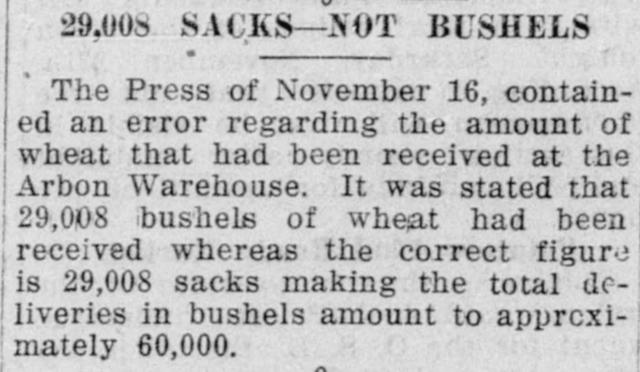
On November 16 the Arbon column passed on a report from E. C. England of Pauline, the warehouse's wheat buyer: the warehouse had handled 29,008 bushels of grain during October, and "that's going some for our weedy crops the past harvest." Two weeks later the Press corrected itself. The figure for what it now called the Arbon Warehouse was 29,008 sacks, not bushels, making total deliveries of approximately 60,000 bushels, about two bushels to the sack.
The first report gave the count for October, while the correction speaks of total deliveries, so it is not clear whether the 29,008 sacks were October's alone or the season's to date. Nor was the warehouse count the valley's whole crop, since some wheat went straight to the switch. No total for 1922 has been found, so the papers do not show whether the July forecast came true.
Seed for another year
In December the county agent reported that Kanred wheat had yielded four to ten bushels an acre more than certified Turkey Red where the two grew side by side. Among the fields compared were Ed Brandt's at Pauline and J. E. Keeler's at Arbon. About 2,500 acres in the county had been sown to Kanred that fall.
Sources
- American Falls Press, March 17, 1922, page 4
- American Falls Press, May 25, 1922, page 4
- American Falls Press, June 29, 1922, page 7
- American Falls Press, July 13, 1922, page 1
- American Falls Press, July 13, 1922, page 4
- American Falls Press, August 3, 1922, page 7
- American Falls Press, August 17, 1922, page 1
- American Falls Press, August 17, 1922, page 5
- American Falls Press, August 24, 1922, page 1
- American Falls Press, August 24, 1922, page 5
- American Falls Press, August 31, 1922, page 6
- American Falls Press, September 28, 1922, page 1
- American Falls Press, September 28, 1922, page 5
- American Falls Press, November 16, 1922, page 8
- American Falls Press, November 30, 1922, page 5
- American Falls Press, December 14, 1922, page 3