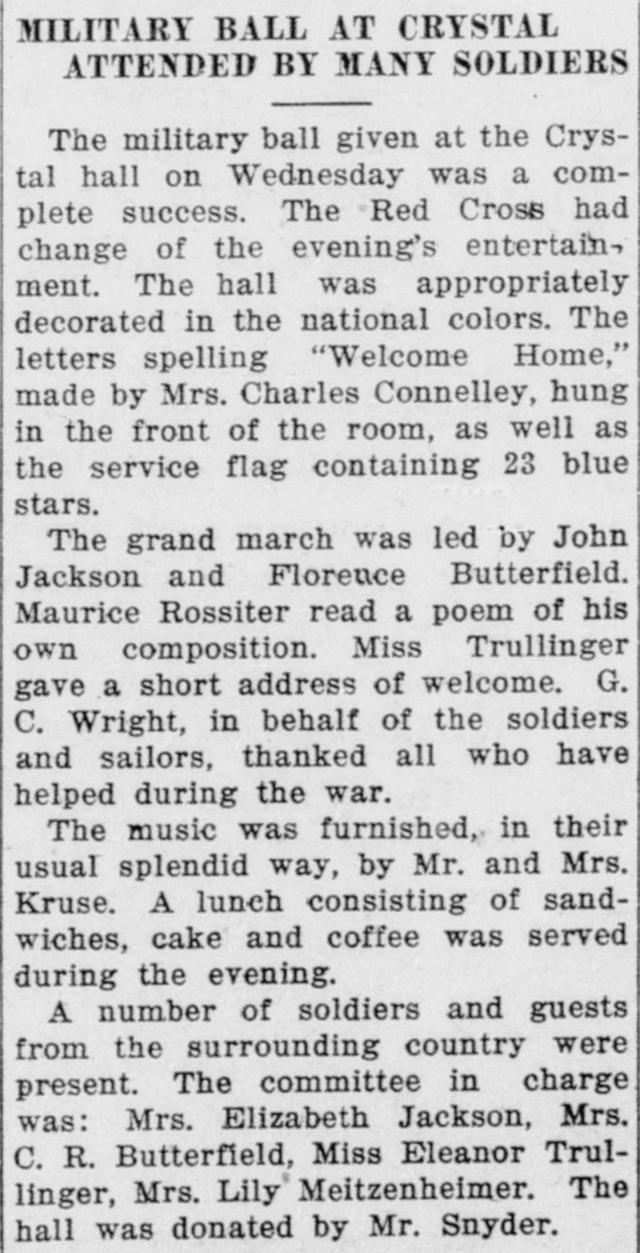
In the First World War the women of Arbon and Crystal formed Red Cross societies, and Pauline had a branch too. They met in one another's homes and in the schoolhouses to sew and knit for soldiers, and raised money with suppers, dances and auctions. The American Falls Press followed them from the summer of 1917 until the Red Cross welcomed the soldiers home with a ball at the Crystal hall in October 1919.
The valley had been in Oneida County until 1913 and was now part of Power County, whose Red Cross chapter was at American Falls. In the national Red Cross drive of June 1917, John Bowen, E. H. Davis and J. Bailey worked at Arbon and Mrs. Logan and others at Pauline, and Arbon, Crystal and Pauline were all reported to have "raised in excess of their apportionment." The county chapter bought the materials that auxiliaries around the county worked up, and in August it asked every wheat grower for the first sack of his harvest.
Face cloths and a sack of wheat
The Arbon society was organized in August 1917 with fifteen members, who met every other Saturday. Mrs. T. B. Evans, Susannah Evans of the Evans family, was chairman, with Mrs. William Allard, Mrs. Charles Porter and Mrs. J. E. Keeler as the other officers. Its first work had to wait for material; in late October the members hemmed face cloths at Mrs. Allard's home, and those who could not come sent word for work to do at home, "which shows the ladies here are not slackers," the Arbon correspondent wrote.
That month the ladies of Crystal organized a chapter of their own, with Mrs. J. W. Staley as treasurer and Mrs. Warren Price as secretary. In December the Crystal column announced that Mrs. Emma Green would teach the schoolchildren to knit at the chapter's Saturday meeting at Crystal's Central school house.
On Saturday, November 17, 1917, the Arbon society had charge of a supper and dance at Arbon's Central school. In the afternoon, at a meeting on good roads, the Army Y.M.C.A. and the Red Cross, about forty farmers gave a sack of wheat each to the county chapter, from a harvest the Arbon column had put in August at eight to twelve bushels to the acre. At six the women brought supper for a crowded house, speakers from American Falls talked, and the evening ended in dancing, with many from Pauline. On New Year's Eve the society gave a turkey supper and dance at the same schoolhouse "under the direction of our efficient president, Mrs. T. B. Evans."
Kits, socks and plowing
In March 1918 the Crystal women set out to make comfort bags for six Crystal boys soon to be called. That spring the Arbon society made night kits and comfort kits at Mrs. Evans's home, and the Junior Red Cross at the Valley View school at Arbon got 1,400 gun wipers ready, its teacher, Mrs. Mary L. Barker, wrote. In April, at Crystal, after a Red Cross auction at which everyone gave things to be sold and then bought them back, the Crystal column reported:
They cleared something like sixty-six dollars. After the sale the young people danced and all went home feeling good after having done their bit to help the good cause along.
Due to the scarcity of help here since so many of our boys are serving their country, several of the women and girls are working in the fields plowing and harrowing.
In June, with Mrs. J. C. Davis now chairman of the Crystal Red Cross, a roll of honor posted at the store named the women sewing and knitting, and the correspondent wrote that most, if not all, of the Crystal boys due to register for the draft had already enlisted. Later that month Eldred Burwell of Crystal was called to Camp Lewis, in Washington. At Arbon, the column of September 3 gave the knitting its due:
We have done our part in knitting for soldiers, or rather Mrs. C. D. Porter has, she having knitted since July 1st fourteen pair of socks and two sweaters up to August 27 and did considerable garden work besides and duties in the house. The Arbon Red Cross chapter has several good knitters who are doing their bit.
That October, as the influenza closed Arbon's Central school, farmers were asked again for sacks of wheat, and the Arbon chapter was called to meet at Mrs. Evans's to reorganize.
Word from France
In December 1918 the Press printed the county chapter's honor roll of the 366 Power County men accepted for service. Six had died, among them John Daniels of Pauline, who died of influenza at Camp Fremont, and Farrell H. Leishman of Arbon, reported dead in a hospital in France. He had come from Utah to live at Arbon with his brother Newell, probably the Newell Leishman who was Arbon's first rural mail carrier. The next week the Press reported a letter to Newell, written several days after the reported death: Farrell was feeling fine and expected to be home for Christmas. On December 24 it reported that the announcement had "happily turned out to be an error": the soldier who died was a Utah relative of the same name. The Stories tell of Corporal David Davis, killed in France, and the men who came home wounded.
Counting up and coming home
In January 1919 the chapter printed what each branch had made since the war began: from Crystal, 147 pairs of socks, 37 sweaters and 117 bed shirts; from Arbon, 41 pairs of socks, 66 bed shirts, 23 pajamas and 10 comfort kits; and from Pauline, 13 pairs of socks, 7 sweaters and 17 bed shirts. In April the Crystal chapter recorded resolutions on the death of Mrs. John Staley, almost certainly Mrs. J. W. Staley, its first treasurer, "a conscientious member and an untiring worker."
By late September Eldred Burwell was back from overseas, and the Press of October 10 reported that Sherman Roper, son of Mr. and Mrs. Walter Roper of Arbon, had arrived home the week before from the American Expeditionary Forces, having come through many of the larger battles "without a scratch." That month the Red Cross took charge of a military ball at the Crystal hall:
The hall was appropriately decorated in the national colors. The letters spelling "Welcome Home," made by Mrs. Charles Connelley, hung in the front of the room, as well as the service flag containing 23 blue stars.
John Jackson and Florence Butterfield led the grand march, Maurice Rossiter read a poem of his own, and C. Wright, "in behalf of the soldiers and sailors, thanked all who have helped during the war."
Sources
- American Falls Press, June 22, 1917, page 1
- American Falls Press, June 22, 1917, page 8
- American Falls Press, August 10, 1917, page 1
- American Falls Press, August 21, 1917, page 3
- American Falls Press, October 23, 1917, page 3
- American Falls Press, October 30, 1917, page 3
- American Falls Press, November 13, 1917, page 1
- American Falls Press, November 20, 1917, page 1
- American Falls Press, November 20, 1917, page 3
- American Falls Press, November 20, 1917, page 4
- American Falls Press, November 27, 1917, page 3
- American Falls Press, December 11, 1917, page 3
- American Falls Press, January 8, 1918, page 4
- American Falls Press, March 5, 1918, page 4
- American Falls Press, April 9, 1918, page 3
- American Falls Press, April 30, 1918, page 4
- American Falls Press, May 10, 1918, page 8
- American Falls Press, May 14, 1918, page 8
- American Falls Press, May 17, 1918, page 4
- American Falls Press, June 11, 1918, page 3
- American Falls Press, June 25, 1918, page 2
- American Falls Press, September 3, 1918, page 3
- American Falls Press, October 22, 1918, page 4
- American Falls Press, December 10, 1918, page 2
- American Falls Press, December 10, 1918, page 4
- American Falls Press, December 17, 1918, page 3
- American Falls Press, December 24, 1918, page 1
- American Falls Press, January 17, 1919, page 10
- American Falls Press, April 25, 1919, page 7
- American Falls Press, September 26, 1919, page 5
- American Falls Press, October 10, 1919, page 5
- American Falls Press, October 17, 1919, page 5