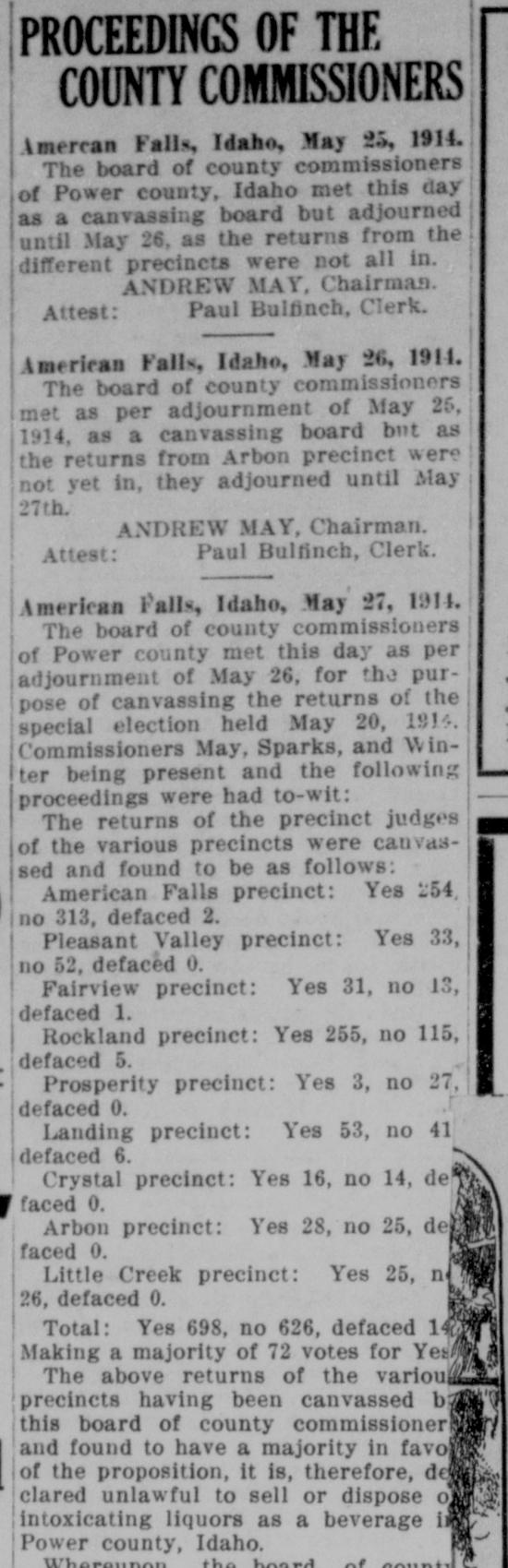
On May 20, 1914, the voters of the new Power County decided whether the sale of liquor would be forbidden across the county. The county went dry by 72 votes, and the two Arbon Valley precincts were among the closest in it: Arbon voted dry 28 to 25, and Crystal 16 to 14. The American Falls Press followed the campaign and the count, which had to wait for Arbon.
A question for the whole county
Idaho's local-option law let a county vote, as a single unit, on whether to prohibit the sale of intoxicating liquor as a beverage. The valley had voted on it before. On May 25, 1910, while Arbon was still a precinct of Oneida County, that county voted itself dry. The Press headline read "Oneida County in Dry Column. Votes Four to One Against Saloons," and the paper called the outcome "a foregone conclusion." The complete returns were 1,968 for prohibition and 561 against. Arbon appears in the table of precincts, but in the digitized text its figures cannot be told apart from the others'.
In 1913 Arbon and Crystal became part of the new Power County. In April 1914 the Press printed a district court opinion in a suit by the village of American Falls against the only saloonkeeper the new county had licensed, whose saloon stood across a bridge from the village. The court held that the saloon was a nuisance and that "Power county is a unit," four-fifths of which had been dry territory when the county was created. The commissioners had already ordered, on April 17, a special election for the whole county. The Press urged everyone to vote:
An election is to be held in Power county on Wednesday, the 20th day of May, for the purpose of settling for all time the question as to whether or not the county shall be wet or dry whether or not saloons shall operate within the county. Every citizen of the county should make a special effort to express his or her views by voting upon this very important question even if it requires some little sacrifice of work or business.
The campaign
On April 30 the Press announced that J. A. Maples of Texas, known as "The Texas Cyclone," would "open the local option campaign in Power county," speaking in American Falls on the Monday and Tuesday nights. It went on:
His addresses are perennial flows of eloquence and irresistible logic, and his beautiful spirit makes him friends wherever he goes.
Everyone interested in the carrying of Power county against the saloons should attend these meetings.
No report of meetings in the valley itself has been found. On election day Arbon precinct voted at the schoolhouse in District No. 12, probably the Central school, also known as Green Top, and Crystal precinct at the schoolhouse in District No. 14.
Waiting for Arbon
The next day's Press was headed "County Is Dry by Small Margin." The election, it said, had been "rather a quiet affair." The surprise was in town: the American Falls precinct, expected to go dry by about fifty votes, had gone wet by fifty-nine, while Rockland went dry by more than two to one. Seven of the nine precincts were in and the drys were ahead, but Arbon and Crystal had not reported.
The paper recalled that at the Oneida County election, which it placed five years back (it was four), the old Arbon precinct had covered both of them, and "it is said that the vote went about four to one dry." On that reckoning the valley would only add to the dry lead. Others, who claimed to be in touch with the valley, expected the two precincts to go wet, and some seemed confident of "a majority for the wets that will be great enough to overcome the lead which the prohibitionists now have."
The county commissioners met as a canvassing board on Monday, May 25, and adjourned because "the returns from the different precincts were not all in." On May 26 they adjourned again, because the returns from Arbon precinct had still not come. On May 27 they canvassed the vote.
The count
Arbon precinct voted 28 for prohibition and 25 against, and Crystal 16 for and 14 against. Across the county the total was 698 for and 626 against. American Falls, Pleasant Valley, Prosperity and Little Creek had gone wet; Rockland, Fairview, Landing, Crystal and Arbon dry. The board declared it unlawful to sell or dispose of intoxicating liquors as a beverage in Power County. Together the valley's two precincts added just five votes to the dry majority: the lead grew, as the paper had expected, but by nothing like four to one.
Fewer valley voters turned out than in the county's road-bond election that January, when Arbon cast 148 votes and Crystal 42. In May, Arbon cast 53 and Crystal 30. The papers do not say why. Among the election judges the county paid that summer were David B. Ripley and John Payne, probably D. B. Ripley of the east-side ranch and the Arbon storekeeper John Payne, George Arbon's son-in-law (see the Arbon family). The bills do not say which precinct either served.
After the vote
Liquor still turned up in the valley's news. On June 19, 1914, the Ogden Daily Standard reported that two suitcases "alleged to have been stolen" from C. E. Pellum of Arbon at the Ogden Union depot on the night of Wednesday, June 17, had been found that morning by Patrolman James Hearn, in a clump of weeds behind a machine shop. "One of the suit cases contained a quantity of whiskey and the other the personal effects of Mr. Pellum."
In September 1915 the South Arbon correspondent of the Press wrote that Lett Robinson had been "requested to contribute $50.00 to the county fund": he had been caught bootlegging, arrested and fined $50. Several others in the valley, the writer added, were "thought to be conducting the same sort of business, but so far have been lucky enough to keep out of sight of the officers." No other report of the case has been found.
By then the question had passed beyond the county. On December 30, 1915, the Press wrote that "Saturday morning every saloon door in Idaho will be closed." Statewide prohibition began on January 1, 1916.
On this site: the histories of Arbon and Crystal, and, for the Prohibition years, a moonshine still on Bannock Creek and the Summit history, which remembers a still in Bull Canyon.
Sources
- American Falls Press, May 28, 1910, page 1
- American Falls Press, June 4, 1910, page 1
- American Falls Press, February 26, 1914, page 5
- American Falls Press, April 23, 1914, page 2
- American Falls Press, April 23, 1914, page 6
- American Falls Press, April 30, 1914, page 1
- American Falls Press, May 14, 1914, page 11
- American Falls Press, May 21, 1914, page 1
- American Falls Press, May 21, 1914, page 11
- American Falls Press, May 28, 1914, page 12
- Ogden Daily Standard, June 19, 1914, page 7
- American Falls Press, July 30, 1914, page 2
- American Falls Press, September 16, 1915, page 2
- American Falls Press, December 30, 1915, page 2