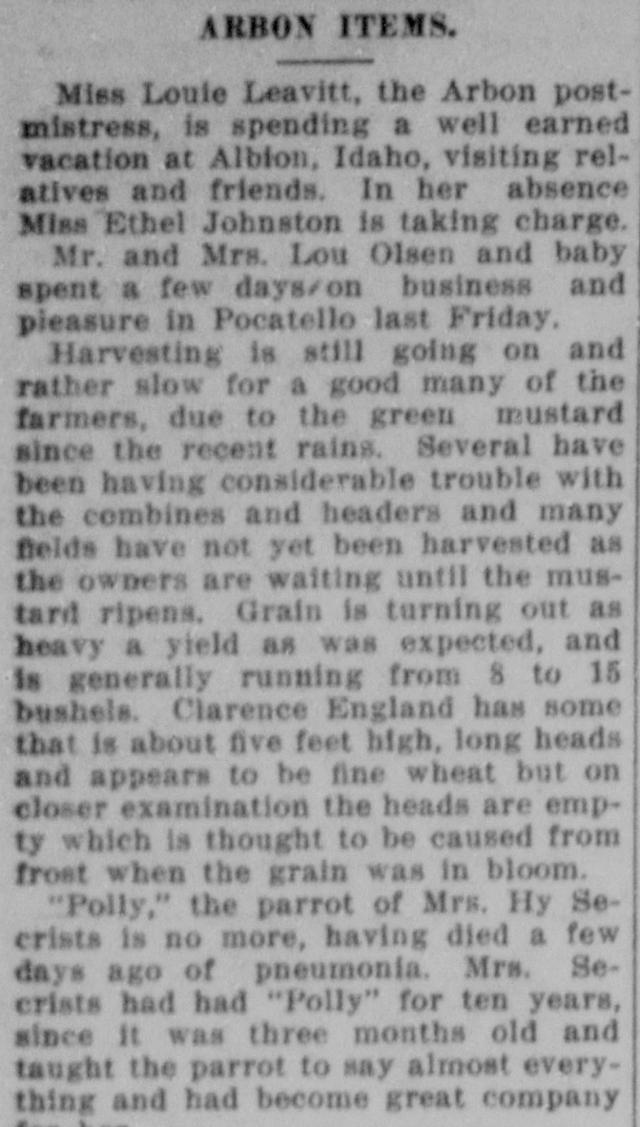
One night late in the summer of 1917, people in Arbon said, an aeroplane flew over the valley. The story appeared on September 7, 1917, in the Arbon column of the American Falls Press, a column that also covered a slow harvest, the postmistress's vacation and the death of a parrot.
Arbon had been part of Oneida County until Power County was formed in 1913. The Press, published at the new county seat of American Falls, carried news from Arbon in a regular column.
A noise at the gate
The story began with a sound. "Last week," the column said, John Fuller's family thought they heard a car drive up to their gate and stop. They went out to look and saw no car, although it had sounded like one close by.
Never thinking to look up they went back into the house and next morning Hebe Woods came to the Fuller home and asked them if they had seen the aeroplane the night before, which was the noise they heard.
The aeroplane, the column went on, "came from the west and went on toward the southeast." Hebe said it had passed so close that he "could see the shape of it." "Many others also saw the big bird," the correspondent added, and some who had missed it could be seen any time going about "looking up in the sky for another."
The column dates the night only as "last week," so it probably fell in the last days of August or the first days of September. It says nothing of lights, the hour or the weather.
By April 1916 John Fuller and his wife had charge of the Central hall and held dances there every Saturday evening. "Hebe Woods," as the column printed the name, was probably Heber Wood, who had lived in the valley since at least 1911; in January 1918 the Press placed the Wood ranch "well over to the east side of Arbon valley." The site's Andersen family history records that in the deep snows of 1911–12, besides family, the Arnn family and Heber Woods were about the only people George Andersen and Beth saw until the thaw.
The rest of the column shows the valley that week. Harvest was slow. Green mustard had come up since the recent rains, several farmers had trouble with their combines and headers, and many fields stood uncut while their owners waited for the mustard to ripen. Clarence England had wheat with long heads that looked fine, but "on closer examination the heads are empty," which was blamed on frost while the grain was in bloom. Louie Leavitt, the postmistress, was visiting at Albion, with Ethel Johnston in charge of the office. And a parrot named Polly, which its owner had kept for ten years and taught to say almost everything, had died of pneumonia; the owner's name cannot be made out in the surviving scan.
Was it an aeroplane?
No other mention of the flight has been found in the issues of the Press read for this post, from late August through the county fair in mid-September. No one named a pilot, a route or a reason for the trip.
The same paper shows what it took to bring an aeroplane to Power County that year. The Power County Fair at American Falls, held the week after the Arbon column appeared, promised that "Aeroplane flights every afternoon will be the biggest attraction." The fair had signed a contract with an aviator from Seattle, and word came that his "aeroplane was boxed ready for shipment." Neither he nor a second aviator who offered to take his place reached the fair. Afterward the Press reported:
The only cause for complaint the officers have is the breaking of the contract they had made with a Seattle aviator. Had the man been frank with them they could have secured another aviator.
On the page that carried the Arbon column, the other aeroplanes were in the war news: a visit by a writer for the Paris Matin to an American aviation camp in France, and German airplanes over the Gulf of Riga.
Arbon was not the only place to report such a thing that summer. In western North Dakota in July and August 1917, as Prairie Public's Dakota Datebook has retold from the papers there, people reported the hum and lights of aeroplanes at night, and the explanations offered ran from German agents to bootleggers to student fliers.
Looking up
Two months later the Press's roving writer, who wrote as "the Pilgrim," was making his way through the valley. He described a lone pine on the Mink Creek divide that could be seen from the valley north of Pauline and pointed the way to the Mink Creek pass. When airship service came, he wrote, and automobiles were "relegated to the rear," that tree would be the "pilot's guide." To anyone who thought that a long way off, he answered that most people could remember scoffing at "horseless carriages." "This old world keeps a-moving," he went on, "and progress is the order of the day."
By January 1918 the Crystal column reported that Leroy Johnston had enlisted in the aviation corps and was at Salt Lake, expecting to be sent to Texas with six hundred others for training.
The site's list of firsts gives the earliest airplane on record over the valley as a National Parks Airways mail plane whose pilot reported a forest fire west of Arbon on July 30, 1929. The night in 1917 came twelve years earlier, but it rests on what neighbors saw and heard, as one column reported it, not on any record of a flight.
On this site: the first airplane over the valley, the Andersen family and the Arbon area history.
Sources
- American Falls Press, April 27, 1916, page 6
- American Falls Press, September 7, 1917, page 8
- American Falls Press, September 11, 1917, page 1
- American Falls Press, September 18, 1917, page 1
- American Falls Press, November 6, 1917, page 3
- American Falls Press, January 8, 1918, page 3
- American Falls Press, January 29, 1918, page 4
- Prairie Public, Dakota Datebook, "Phantom Flyers," May 16, 2022