In the middle of June 1916, the settlers who had come to Arbon Valley from the state of Washington held a three-day picnic in Bull Canyon, at the Summit end of the valley, and this time invited the rest of the county to join them. The American Falls Press announced and reported it, and its columns from the years before show how these "Washington people" came to be there.
A newspaper mailed to Dayton
The Dayton connection began, as far as the papers show, with one copy of the Press. On April 17, 1909, the paper ran a front-page feature on the Arbon valley, then part of Oneida County. Paul Ellis of Aberdeen mailed his copy to R. E. Smith of Dayton, a wheat town in southeastern Washington near Walla Walla. On May 22 the Press reported the result: on May 19 Smith and two other Dayton men had filed on homesteads in Section 11 of Township 12 South, Range 33 East, about eight miles south of Arbon. Smith told the paper:
We find the country better than we expected. It looks mighty good to a Washington man to find level land, and there will be a lot more people from Dayton here as soon as we get home.
The filing list on the same page names them as Isaac S. Broyles, Roy F. Payne and Ray E. Smith. That October Mrs. Mima Johnson of Dayton filed on the fourth quarter of the same section.
"Quite a settlement of Washington people"
More came in the following years, from Dayton and other parts of eastern Washington. In September 1914 five railroad cars of immigrants' goods arrived at American Falls from Endicott and Farmington, in the Palouse wheat country, with Tracy Lee, John Farrington and others bound for the Arbon country, which had been part of the new Power County since 1913. Late in March 1915 Tom Donnelly and two other Dayton men came in with two carloads of stock and farm implements; Donnelly meant to start a stock ranch, and the paper said the Donnelly brothers had many friends in the valley, many of them old acquaintances from Dayton. The Arbon correspondent wrote that there was "quite a settlement of Washington people here."
Through 1915 the valley columns kept track of them. Jack Folsom and his bride came from Dayton to make their home. The Hatley and John Bryant families were reported on their way overland from Washington with their stock and household goods, having set out late in May. A Mr. Fletcher from Dayton bought Clarence Barrett's homestead while Mrs. Fletcher stayed with her parents, Mr. and Mrs. Phil Hatfield. Thomas Zimmerman of Dayton bought the S. Randall place, a full section, and in November Leslie Gosney's father and family arrived from Dayton to stay. On the ball field the South Arbon boys were known as the "Daytonites."
The group already had a picnic of its own. In July 1915 the South Arbon column reported their "annual picnic" in a canyon whose name the scan garbles, and a week later described a picnic "given by the Washington people" with more than seventy grown people, a host of children, a program, and ice cream, candy and lemonade. Whether the two notices describe one gathering is not clear.
There were losses too. In February 1916 Ben Messinger, one of the Dayton homesteaders, was found dead from gas in an Ogden rooming house, and his body was taken home to Dayton for burial; his death is one of the site's Stories.
Three days in Bull Canyon
On June 8, 1916, the Press announced on its front page that the Arbon valley settlers from Washington would hold a three-day picnic in Bull Canyon on the 15th, 16th and 17th, and that they invited "all other residents of the county." It estimated that "probably fifty families, formerly from the state of Washington, have located practically in a body, in the Arbon valley," with another settlement across the mountains at the head of Rockland Valley. "Power county has more people from Washington, it is believed, than from any other state," the paper added, and a Washington society would probably be organized at the picnic. Bull Canyon, it said, was well watered and shady, "a sheltered nook little affected by winds."
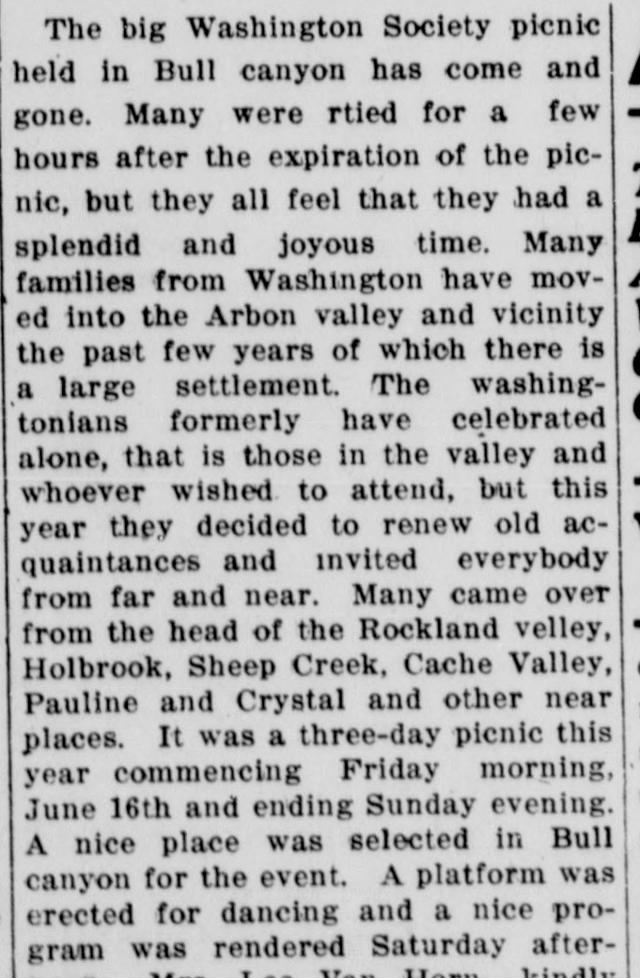
The Arbon column of June 22 reported that "the big Washington Society picnic" had "come and gone." It ran from Friday morning, June 16, to Sunday evening, a day later than announced.
The Washingtonians formerly have celebrated alone, that is those in the valley and whoever wished to attend, but this year they decided to renew old acquaintances and invited everybody from far and near. Many came over from the head of the Rockland valley, Holbrook, Sheep Creek, Cache Valley, Pauline and Crystal and other near places.
A platform was built for dancing, a program was given on Saturday afternoon, and Mrs. Lee Van Horn lent her piano for the occasion. P. W. Lee ran a stand serving hot lunches, and E. H. Davis one selling confections. There were horse races, ball games and dancing, and camping parties lined the hillsides and groves.
The committee had put up signs for those coming into the canyon from the east. The first gave a short distance to the picnic grounds; a little farther on, another said "Three Miles." At an old sawmill site, where sawdust lay piled up, a sign offered "Hay for Sale." Then came "Wrong Road," and at last "No, Here It Is," and "over the brink a few steps we were on the grounds."
The only accident came on Saturday morning, when Emmett Lee was hit over the eye while playing ball. Dr. Schlitz, "a former Washington man himself," was on the grounds and put a couple of stitches in the cut, and the injury was not serious. John Bryant's family, overland travelers of the year before, came over from Crystal, and Marshal Johnson and Mr. Zimmerman of American Falls came out on business and "to chat with old friends" from Washington at the picnic.
The papers found so far do not say whether the Washington society was formally organized, or whether the picnic was held again. The following week, the Arbon column reported that Roy K. Smith had sold his ranch to "a Mr. Zimmerman from Dayton, Washington," for $4,000. In 1924 the Press reported the burial of John Messinger, "an old timer of Dayton, Washington" (it did not say whether he was related to Ben), known to the old residents of Dayton and its neighborhood, "many of them living at present in Power county."
Sources
- American Falls Press, April 17, 1909, page 1
- American Falls Press, May 22, 1909, page 1
- American Falls Press, October 16, 1909, page 3
- American Falls Press, September 17, 1914, page 1
- American Falls Press, April 1, 1915, page 1
- American Falls Press, April 29, 1915, page 4
- American Falls Press, June 3, 1915, page 4
- American Falls Press, June 17, 1915, page 1
- American Falls Press, June 24, 1915, page 8
- American Falls Press, July 8, 1915, page 2
- American Falls Press, July 15, 1915, page 1
- American Falls Press, September 16, 1915, page 2
- American Falls Press, September 30, 1915, page 5
- American Falls Press, November 11, 1915, page 5
- American Falls Press, February 10, 1916, page 1
- American Falls Press, June 8, 1916, page 1
- American Falls Press, June 22, 1916, page 8
- American Falls Press, June 29, 1916, page 6
- American Falls Press, May 22, 1924, page 5