In the spring and summer of 1917, before the new draft had called anyone, young men from Arbon Valley were already enlisting. The valley columns of the American Falls Press and the Salt Lake papers' daily enlistment lists name them a few lines at a time.
On April 5, 1917, the Press printed the resolution by which Congress declared a state of war with Germany. Arbon, in Oneida County until 1913, was now in Power County, and the Press, at the county seat, carried its news.
The first to go
Three weeks later the "Arbon Gossip" column, between Jesse Secrist's trip to Logan to be married and the mail carrier's change from car to sleigh at Pauline, reported: "Reese Waylitt has enlisted in the U. S. army at Pocatello and has left for the training camp." He was probably the Reese Waylett named on the county's honor roll in 1918.
On May 14 the Salt Lake Telegram ran a short item under the headline "Spurred to Enlist by Half-Brother Serving in China":
Ormandel Darling of Arbon, Ida, presented himself this morning at the marine recruiting station for enlistment, was examined, and will be sent away to training headquarters this afternoon. He is a native of Idaho.
His half-brother Nelson, a Salt Lake man whose surname is blurred in the digitized page, was serving at Peking with the Thirty-ninth Company of the legation guard, and Darling said it was his brother's letters that made him enlist. The county's honor roll, as digitized, has no Ormandel, but it lists an Ora Darling, and an Ora Darling had been on the committee to bring brush for the bowery at Arbon's Pioneer Day in 1916. Ormandel was possibly the same man.
The Salt Lake Tribune of June 3 listed "Hyrum F. Bandy, Arbon, Idaho" among the men who had applied at the army recruiting office the day before. The Arbon column of June 5 knew only that Hiram Bandy had gone to Pocatello "on an extended visit." A week later it had word from him that he had enlisted and was training at Fort Douglas, the army post at Salt Lake City. He was a son of George W. Bandy, who farmed at Arbon.
In between, on June 5, every man from 21 to 30 had to register for the new selective draft. William Allard registered the Arbon precinct at the Central school and Ed England the Pauline precinct.
Into the navy
On July 12 the Tribune printed "A. King, Arbon, Idaho" among the navy's new enlistments at Salt Lake, and the Herald-Republican listed the same name. The Arbon News of July 27 told what was probably the same enlistment in its own way:
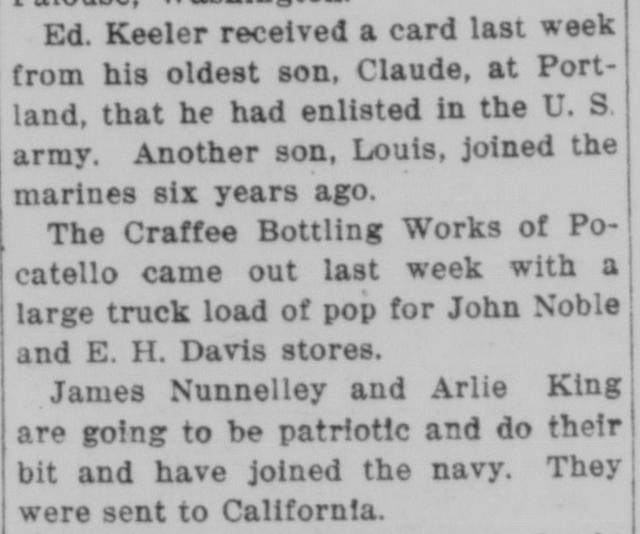
James Nunnelley and Arlie King are going to be patriotic and do their bit and have joined the navy. They were sent to California.
The same July column reported that Ed Keeler had a card from his oldest son, Claude, at Portland, saying that he had enlisted. Another son, Louis, had joined the marines six years before. The column added that several young men of the Pauline and Arbon precincts had been drawn under the new draft law.
That week the army recruiting officer at Pocatello sent the Press a list of Power County volunteers and word of a plan to give each home a service flag "indicating how many men that home has sent." No valley man is among the names that can be read.
On November 19 Jesse W. Keeler of Arbon enlisted in the navy at Salt Lake.
Crystal's fourteen
At Crystal, the high basin fed by Midnight and Rattlesnake creeks, the column of October 2 said that a Mr. McClain's ranch, three miles northwest of Crystal, was "entitled to the distinction of being designated as a recruiting station for Uncle Sam's army." Four of his harvest hands had left farm work for the army or navy. Melvin Meadows had joined the navy (before the war: in September 1918 the column said he had enlisted more than two years earlier), Art Hottel the Second Idaho and Ambrus Moore the army, and John Jackson was leaving that week, called up for the national army. At Thanksgiving John and Casper Fannin, sons of Moses Fannin and both in the navy, came home from Bremerton, Washington, before they were to sail for France. On December 11 the column reported that Melvin Meadows had sailed, and went on:
Another Crystal boy has volunteered his services to Uncle Sam. Alma Butterfield enlisted last week and will leave for Camp Lewis in the near future. This makes a total of fourteen boys from Crystal who have gone to fight for freedom.
The column did not say how many of the fourteen had volunteered and how many had been drafted.
Three stars in the window
The enlisting went on into 1918. Leroy Johnston of Crystal joined the aviation corps that winter and was sent to Texas, and on May 31 Alfred R. Whiting of Crystal enlisted in the army at Salt Lake.
In May 1918 the Keelers had a letter from Claude in France, Jesse was on the ship Alabama, and a third son, probably Louis (the name is blurred in the digitized page), was in the army at Laredo, Texas. "Mr. and Mrs. Keeler have their service flag of three stars in the window," the Arbon column said. That October Claude had recovered from the Spanish fever, Louis wrote that he was still at the training camp in Texas and "very anxious to go across," and George W. Bandy heard from Hiram at Camp Devens, Massachusetts, that his company expected soon to be leaving "to get the Kaiser."
After the Armistice the Press printed the honor roll of 366 names compiled by the Power County Chapter of the Red Cross, including the men who had volunteered before the draft law, with a note: "The local draft board's records do not include the volunteers." On it are Ora Darling, Hyrum P. Bandy (the Tribune had printed F.), Reese Waylett, Melvin Meadows, Casper Fannin, Alma A. Butterfield, Arthur L. Hottel, John Le Roy Johnston, Reese Whiting (probably Alfred R.) and three Keelers: James C. (probably Claude), Jesse W. and Louis A. Arlie King and James Nunnelley do not appear in the digitized text of the list.
Not everyone came home unhurt. The site's Stories tell of Corporal David Davis, who had lived at Arbon and was killed in France; of the men who came back wounded, among them the Keelers' nephew Mirlan Hallett; and of John Emer Daniels of Pauline, who died at Camp Fremont.
On this site: the area histories of Arbon, Pauline and West Fork and Crystal.
Sources
- American Falls Press, August 3, 1916, page 4
- American Falls Press, April 5, 1917, page 1
- American Falls Press, April 26, 1917, page 3
- Salt Lake Telegram, May 14, 1917, page 7
- American Falls Press, May 22, 1917, page 1
- Salt Lake Tribune, June 3, 1917, page 24
- American Falls Press, June 5, 1917, page 2
- American Falls Press, June 12, 1917, page 4
- Salt Lake Tribune, July 12, 1917, page 8
- Salt Lake Herald-Republican, July 12, 1917, page 8
- American Falls Press, July 24, 1917, page 1
- American Falls Press, July 27, 1917, page 5
- American Falls Press, October 2, 1917, page 2
- American Falls Press, October 30, 1917, page 3
- Salt Lake Tribune, November 20, 1917, page 9
- American Falls Press, November 30, 1917, page 2
- American Falls Press, December 11, 1917, page 3
- American Falls Press, January 29, 1918, page 4
- American Falls Press, April 16, 1918, page 4
- American Falls Press, May 24, 1918, page 4
- Salt Lake Tribune, June 1, 1918, page 10
- American Falls Press, September 10, 1918, page 4
- American Falls Press, October 8, 1918, page 4
- American Falls Press, December 10, 1918, page 2