In the 1923–24 school year, the American Falls Press printed news from Arbon Valley written by its schoolchildren. Pupils at Pauline, Crystal, Valley View, Arbon and the smaller country schools sent in weekly notes about their neighbors, the weather and their lessons, printed as the children wrote them.
A language lesson in print
Arbon Valley, in Oneida County until 1913, was by then in Power County. On November 1, 1923, the Press announced that it would be mailed free every week to thirty-one rural schools in Power County. One language lesson a week would be news items for the paper, and the Press would print them "identically as written." The county superintendent of schools, Mrs. Cora Darling, said of the plan, "And best of all it lends human interest to a study that is often dry." A week later teachers were asked to send the items uncorrected; spelling and grammar were to be put right after they appeared in print.
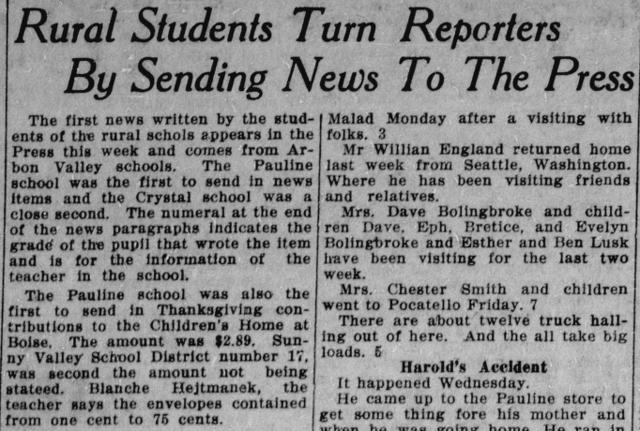
The first items came from this valley. On November 15 the paper reported:
The first news written by the students of the rural schools appears in the Press this week and comes from Arbon Valley schools. The Pauline school was the first to send in news items and the Crystal school was a close second. The numeral at the end of the news paragraphs indicates the grade of the pupil that wrote the item and is for the information of the teacher in the school.
A winter of news
In November the Pauline pupils reported that Jim McNichols's straw stack and barn had burned and that a well was being drilled at the schoolhouse. A third grader explained what freighting meant: "Mr. T. D. Lusk is freighting that means going to and from the switch and the switch means Schiller." Schiller was the railroad point 26 miles away where the grain from the Pauline warehouse went. At Crystal a pupil reported a classmate's answer in school that foreign commerce "is the thing you find at the end of every sentence."
On December 6 the Press printed a "First Lesson in News Writing" for "the hundreds of reporters in the rural schools of the county." It said, "Primarily, what people think about, talk about and do, is news," and told them to "Write plainly on one side of the paper only and use ink where possible."
On December 13 a Pauline third grader wrote: "Mr. Press, how can we catch up with you? We are away behind. Each week you tell us what we were doing two weeks ago." On December 20 the Arbon school column reported, "The frost is so heavy at Arbon that it has broken down the telephone line." That week the Pauline column reported that Chester Smith, one of the school's two teachers, had taken his room to Allard's to hear a radio, and that the blacksmith was building a garage.
In the first issue of 1924 the paper announced that "Valley View school has organized itself into Arbon City." Valley View, one of the Arbon schools, was taught by Joseph Rytting. Each row of seats was named as a street, with a sheriff to keep it clean, and Harold Anderson was mayor. He was probably Harold, the son of Otto Andersen, and the sheriff of Lincoln Street, Mark Anderson, was very likely John and Sena Andersen's son Mark.
Spring
The Press pages for January 10 to February 21, 1924, were not available for this post. In March the Armstrong school, in District 6, apologized: "Will you excuse us for writing on this kind of paper, for we are 26 miles from town—minus paper." Pauline planned a ball game and a ciphering match, a contest in arithmetic, at Valley View: "We're betting on us." The next week's column said, "We were going up to Valley View, Friday to cipher but they were all sick." After one Pauline class wrote compositions about their fathers' shoes, a pupil reported, "Every composition squeaked and it made us laugh."
The Press hid the pupils' names, scrambled, in merchants' advertisements and offered a celluloid desk pad to pupils who found their own names. The first letter claiming a pad came from Pauline, dated March 11, and the paper printed it in full:
Dear Mr. Press: I found my name in the Press but I could hardly tell it, it was so mixed up. I saw the z, and that's what made me find it.
Sincerely, ELIZABETH DANIELS.
P S Thank you for the desk Pad if I get it
Her name had appeared in the Riverside Grocery advertisement as "sellieniadbazthe."
Not every item was printed. On March 27 the Pauline column reported that two of its items had been returned "because they were not fit to put in the paper." That week the Press asked, "Twelve schools wrote letters to the Press this week. Where are the others?" In early April Valley View reported a new election, with Catherine Pett as mayor; she was probably the daughter of Bruce and Annie Andersen Pett. When the older pupils went to Pauline for the state examinations, Price Armstrong's schoolmates wrote "that his science was easy but he said that his geography was catchy."
What the grown-ups said
On April 10 the Press printed letters of thanks from two schools. One, dated at Arbon on March 26, told Mrs. Darling that one period a week went to reading the paper and writing the notes. The paper explained its method:
The rural school letters are written by the students in the schools and are published exactly as written, regardless of grammatical mistakes or spelling. The news, as published, is then clipped from the Press and corrected in the English classes of the various schools.
On May 29 the Press quoted Mrs. Darling's account of the plan in The Idaho Teacher. The notes went through her office first. Some of the first reports "were very amusing and, yet, very interesting," she wrote, and the writing had steadily improved: "The boy who dislikes language, finds a real enjoyment in reading his own notes in the American Falls Press and comparing them with the notes of other boys and girls in another school." In June she reported rural attendance "about twice as good as usual" that year, and credited much of it to the monthly honor rolls in the Press. The papers read for this post do not show whether the children's columns went on the next year.
On this site: the histories of Pauline and West Fork, Crystal and Arbon, and the Schools of Arbon Valley.
Sources
- American Falls Press, November 1, 1923, page 1
- American Falls Press, November 8, 1923, page 1
- American Falls Press, November 15, 1923, page 8
- American Falls Press, November 22, 1923, page 2
- American Falls Press, November 29, 1923, page 2
- American Falls Press, December 6, 1923, page 2
- American Falls Press, December 13, 1923, page 12
- American Falls Press, December 20, 1923, page 2
- American Falls Press, December 20, 1923, page 8
- American Falls Press, January 3, 1924, page 2
- American Falls Press, March 6, 1924, page 1
- American Falls Press, March 6, 1924, page 4
- American Falls Press, March 13, 1924, page 2
- American Falls Press, March 20, 1924, page 1
- American Falls Press, March 20, 1924, page 2
- American Falls Press, March 27, 1924, page 1
- American Falls Press, March 27, 1924, page 2
- American Falls Press, April 3, 1924, page 3
- American Falls Press, April 3, 1924, page 4
- American Falls Press, April 10, 1924, page 2
- American Falls Press, April 10, 1924, page 3
- American Falls Press, May 29, 1924, page 1
- American Falls Press, June 12, 1924, page 2