In late May 1915 Robert W. Sturges, a student at Union Theological Seminary in New York, came to Arbon Valley to serve its two small Congregational churches for the summer. The American Falls Press followed his four months there, and the next January he described the valley in a Congregational missions magazine.
Before he came
A Protestant Sunday school had begun in 1911, meeting at first in homes, and in July 1913 two Congregational churches were organized, one at the Central school and one at Highland, at the south end of the valley in the Summit area (see the first Protestant Sunday school and church and the first congregations at Summit). By the spring of 1914 the Highland church had a building on land given by Miss Mamie Nunnelley, and the school met in it that term. The Rev. Thomas Dent Fee came from Eagle Butte, South Dakota, that April to serve both churches, but by February 1915 a "Rev. Thos. D. Fee," probably the same man, was pastor of the Congregational church at Rockland.
In the spring of 1915 the Sunday school that had met at the Valley View schoolhouse the year before was reorganized as a union school, one not tied to any single church, with a Mr. Bramstedt, probably the homesteader Gus Brahmstadt, as superintendent. By early June it had been discontinued.
Four months, three Sunday schools
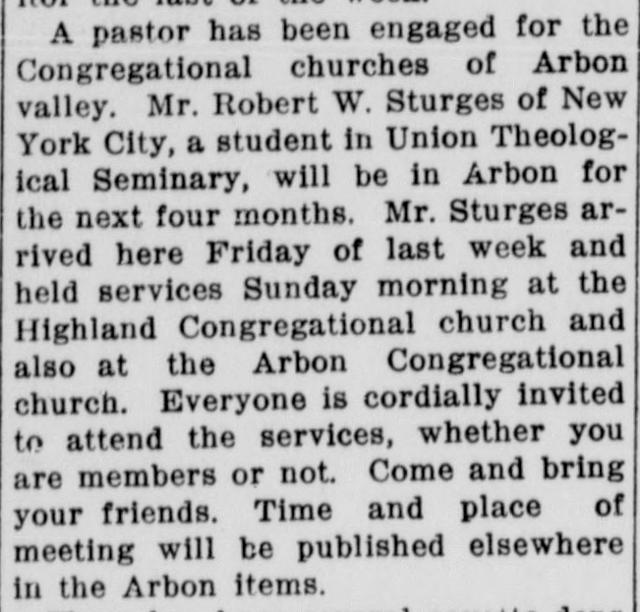
On June 3, 1915, the Press announced the new pastor:
A pastor has been engaged for the Congregational churches of Arbon valley. Mr. Robert W. Sturges of New York City, a student in Union Theological Seminary, will be in Arbon for the next four months. Mr. Sturges arrived here Friday of last week and held services Sunday morning at the Highland Congregational church and also at the Arbon Congregational church. Everyone is cordially invited to attend the services, whether you are members or not.
The South Arbon column on the same page dated his first sermon "to his little congregation at Highland" to Sunday morning, May 23, so the two items disagree slightly. That day the south end's Latter-day Saints met at E. G. Smith's home. On the evening of May 30 his services at Arbon drew a large crowd.
On Sunday, June 6, a Sunday school was organized at the Central school, with William Allard as superintendent, Miss Merle Porter as secretary, Mrs. J. E. Keeler as treasurer and Miss Leslie Featherstone as organist. By July the paper called it the Union Sunday school and said it was "progressing nicely."
The Highland church planned a Children's Day program for Sunday evening, June 27, and Mrs. Emmett Lee was in charge of the Highland Sunday school program. The column later reported a large crowd: "There not being standing room in the house." The printed program of songs and recitations names performers from the Stott, Smith, McCauley, Chapman, Nunnelley and Lee families. One Monday Sturges went up Bannock Mountain with James Smith and, it seems, Charlie Smith; from the top, the column said, they could see Salt Lake and a long stretch of the Snake River.
Sturges also started the Valley View Sunday school again, halfway between his two churches. Its social at the schoolhouse on the evening of July 24 was "largely attended," and the paper credited the school to "R. Sturges, pastor of the Congregational church here." That same day a large crowd kept the 24th of July, the Latter-day Saints' Pioneer Day, at the Pauline L. D. S. grounds. The Highland Sunday school announced a social at its church for Saturday, July 31, and in August the column reported that its young people had given a Saturday-evening social there for the young people of the community, with games, cake and punch.
Farmers at the south end began heading, or cutting, their grain on August 2, and the school trustees bought a lot joining the church lot on Mamie Nunnelley's land, where the Highland school was built that fall. By early September the services at the Central schoolhouse had stopped, and the paper said Sturges would soon leave for his home in California. On September 16 it reported that he had gone "last Monday," to visit the Panama Exposition with his parents before returning to school in New York, and added:
Mr. Sturges has had charge of the Arbon and Highland congregational churches for the past four months and while here has made many friends who hate to see him leave.
His report
In January 1916 The American Missionary printed his short piece "Where Leadership Is Needed." An editor's note called him "a theological student who gave his summer vacation to the field." He described the work as "two churches, about twelve miles apart, and a Sunday-school half way between." The Arbon church met in a schoolhouse, the Highland church owned its building and land, and the Sunday school between them met at the Valley View schoolhouse.
He wrote bluntly for a missionary magazine. He put the valley at "about sixty per cent. Mormon," with Protestant farmers slowly lowering the share, and said Latter-day Saints mixed with Protestants in daily life but seldom came to their services. He judged the valley's schools poor, thought that, given an education, most Latter-day Saints would give up or remake their faith, and welcomed that year's teachers partly because they were not Latter-day Saints. These were one visitor's opinions; the Press columns of that summer report the gatherings of both faiths side by side, without comment. He was no gentler with his own congregations:
The Protestants are also indifferent. They are interested only when they have a more capable leadership than anything the Valley supplies them with just now. They are busy homesteaders, quite apt to work on Sunday, especially in harvest time. Their lives are not quite so barren as their country. They lack education, and so far their children have not had the advantages of good schools.
The missionary most needed, he wrote, was a "really capable school teacher." He also found that "The people are hospitable, and respond fairly well to good leadership."
Afterward
On July 26, 1918, the Press reported his marriage to Miss Merl McClees at Seattle on June 22. He had been training at Camp Lewis since the previous September, and on June 25 a card came from him at Fargo, North Dakota, on his way to New York; it was believed he had sailed for "over there," the war overseas. His bride went back to California while he was away.
The Summit area history says the community church at Highland was discontinued in the early 1920s, after which its empty building sheltered the horses children rode to school.
Sources
- American Falls Press, April 2, 1914, page 11
- American Falls Press, April 30, 1914, page 1
- American Falls Press, February 4, 1915, page 5
- American Falls Press, April 29, 1915, page 4
- American Falls Press, June 3, 1915, page 4
- American Falls Press, June 17, 1915, page 1
- American Falls Press, July 8, 1915, page 2
- American Falls Press, July 15, 1915, page 1
- American Falls Press, July 29, 1915, page 1
- American Falls Press, August 12, 1915, page 4
- American Falls Press, September 2, 1915, page 8
- American Falls Press, September 16, 1915, page 2
- The American Missionary, January 1916, page 612
- American Falls Press, July 26, 1918, page 3