From 1909 to 1914 the American Falls Press carried small notices from the United States land office at Blackfoot naming Arbon Valley settlers who were about to make final proof on their homesteads. Read together, they show how the valley's claims became owned land and which neighbours stood up for one another. Arbon was in Oneida County until 1913, when it became part of the new Power County.
What proving up meant
A homestead entry gave a settler a claim on government land, not title to it. Title, the patent, came only after final proof: the settler had to show, with witnesses, that he or she had lived on the land and farmed it for as long as the law required. Each proof was announced weeks ahead, and each notice named four neighbours as witnesses to the claimant's "continuous residence upon and cultivation of said lands."
There were two ways to finish. A settler could stay the full term, five years at that time. Nephi Jenson of Arbon entered his land in May 1906 and gave notice in October 1911 of "final five-year proof." Or a settler could commute, paying for the land instead of waiting out the term, though the law still required at least fourteen months of actual residence.
John Payne of Arbon, almost certainly the John Payne who kept one of the valley's first stores, commuted. On April 18, 1906, he had entered 80 acres in section 26, township 11 south, range 33 east. In September 1909 the Press printed his notice of "final commutation proof," to be made on October 18 before Theo. Turner, the U.S. commissioner at Pocatello. His four witnesses, all of Arbon, included James L. Payne, probably his son James Lester. The federal land records list John Payne's patent, a cash entry, as issued on September 26, 1910.
The three-year law
On June 6, 1912, Congress cut the term to three years, with leave to be away from the claim for up to five months in each year, and applied the change to entries already made. Proof meant the settler and "two credible witnesses" showing a habitable house on the land and three years of residence and cultivation.
The valley's entries of 1908 to 1910 came due together, and through 1913 the Press ran notices of "final three year proof" week after week, with neighbours vouching for each other. Lawrence Gibbons and Lorin H. Bailey, whose claims shared section 3 of township 11 south, each named the other, and both named Hyrum D. Powell, who named them in turn. All three were to prove up before Turner at Pocatello on October 8, 1913. Lorin Bailey's family history tells how his family and the Gibbonses shared a well drilled on the section line between them. Waldemar Jensen and David T. Lusk named each other in their notices of 1912 and 1913. Elias Horton was named as a witness in at least four notices between 1910 and 1913.
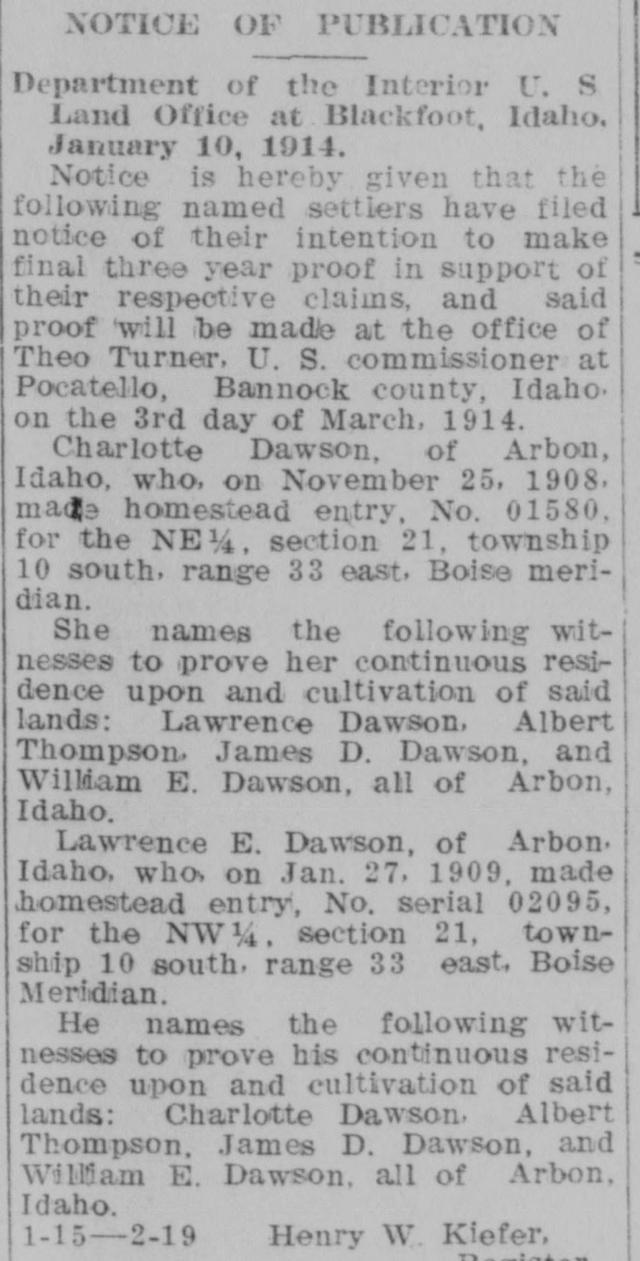
Women proved up on their own claims. Emma Jane Dawson, "formerly Emma Jane Beebe," had made her entry on May 17, 1910; her proof was set for October 6, 1913. Her patent, issued May 6, 1914, is indexed under both names. Charlotte Dawson's notice ran from January 15 to February 19, 1914, beside that of Lawrence E. Dawson, whose quarter section adjoined hers:
Charlotte Dawson, of Arbon, Idaho, who, on November 25, 1908, made homestead entry, No. 01580, for the NE¼ section 21, township 10 south, range 33 east, Boise meridian. She names the following witnesses to prove her continuous residence upon and cultivation of said lands: Lawrence Dawson, Albert Thompson, James D. Dawson, and William E. Dawson, all of Arbon, Idaho.
Lawrence named Charlotte among his witnesses, and their patents were issued on the same day, October 29, 1914. The notices do not say how the Dawsons were related; the site's research notes take Charlotte to be, probably, a widow from Weston whose sons included Lawrence and William.
Claims nobody lived on
The law, as restated in 1912, also provided that if a settler failed to take up residence within six months of entry, or left the land for more than six months, the land could go back to the government after due notice. The Arbon cases in the Press began with a neighbour's contest.
In May 1910 Jewel Horton contested the entry James Berry of Arbon had made on May 2, 1904, on a lot in section 30, township 10 south, range 34 east. As the notice summed up Horton's affidavit, it alleged
that said Berry died about 2 years ago at Deweyville, Utah; that he never did establish a residence or make any improvements upon the entry: that the land is in its native state; that the said Berry left no heirs known to this affiant
A hearing was set at Blackfoot for June 27, 1910; its outcome has not been found. By August 1913 the Press was calling Jewell Horton, probably the same man, the justice of the peace at Arbon.
In December 1912 a Howell of Arbon, whose given names the scan garbles but who was almost certainly Leslie B. Howell, contested Herman J. Kramer's entry of May 13, 1910, in section 20 of the same township. He alleged that Kramer had never lived on the land, built a house or made any improvements; unless Kramer answered, the entry would be cancelled. Howell received his own homestead patent for 160 acres in section 20 on October 5, 1916, probably on the same land.
In April 1913 Byron Messinger's contest was addressed "To the Unknown Heirs of James N. Heusser, Deceased." Heusser had entered land in that same section 30 in August 1911 and had since died; Messinger alleged that neither he nor any heir had lived on it. The records found do not show who got that land. In March 1914 Charles Higgins contested Thomas Craven's 1912 entry on the southwest quarter of section 33, township 11 south, range 33 east, saying Craven had "wholly abandoned" it. Higgins's own patent of March 9, 1916, takes in that quarter.
From sagebrush to the tax roll
In February 1917 the Press counted 289,968 acres of patented land in Power County and looked back:
It is only a few years since nearly all of this land was government land, producing only sagebrush. It is hard to realize that the transition has been so rapid. ... Title to the lands had not passed from the government and paid nothing towards supporting the government. These new lands are now bearing their share.
On this site: the first homestead proved up; John Payne's later life; and the Arbon and Pauline and West Fork area histories.
Sources
- American Falls Press, September 25, 1909, page 7
- American Falls Press, May 28, 1910, page 11
- American Falls Press, October 22, 1910, page 6
- American Falls Press, October 12, 1911, page 8
- American Falls Press, December 12, 1912, page 4
- American Falls Press, December 19, 1912, page 4
- American Falls Press, April 24, 1913, page 3
- American Falls Press, August 7, 1913, page 8
- American Falls Press, September 4, 1913, page 7
- American Falls Press, January 22, 1914, page 5
- American Falls Press, April 30, 1914, page 11
- American Falls Press, February 22, 1917, page 1
- Act of June 6, 1912, amending the homestead laws, 37 Stat. 123
- Patent to John Payne, 1910 (BLM IDBL 0003116)
- Patent to Emma Jane Dawson (Emma Beebe), 1914 (BLM IDBL 0008194)
- Patent to Charlotte Dawson, 1914 (BLM IDBL 0001580)
- Patent to Lawrence E. Dawson, 1914 (BLM IDBL 0002095)
- Patent to Leslie B. Howell, 1916 (BLM IDBL 0013978)
- Patent to Charles Higgins, 1916 (BLM IDBL 0018326)