In the fall of 1917 a correspondent for the American Falls Press who signed himself "The Pilgrim" spent the better part of three months on the roads of Crystal, Pauline and Arbon, mostly on foot. His ranch profiles are stories of their own; this post follows the man himself through his road notes, "Along the Highways."
Arbon had been in Oneida County until Power County was created in 1913. Crystal is a high basin of springs and creeks that feed Bannock Creek, and the valley's north end lies beside the Fort Hall Reservation, which some of the roads and short cuts out of Pauline and Crystal crossed.
A department for farmers
On August 3, 1917, the Press announced a new department on the county's farms, promising that every farmer would be visited by "The Pilgrim" in the course of his travels. On August 31 it reported that he would leave the next week for Crystal and "may possibly get to Pauline and Arbon before returning."
His name was never printed in the columns read for this post. He mentioned that he had "served in the United States regular army," and later that he had "lived in Utah so many years." He also sold subscriptions, and when he moved from Crystal into the Arbon country early in October the Press asked readers to give him their farming methods, their mistakes and $2. The Arbon correspondent wrote that the valley was "looking for the Pilgrim out our way."
Up Mink Creek with the mail
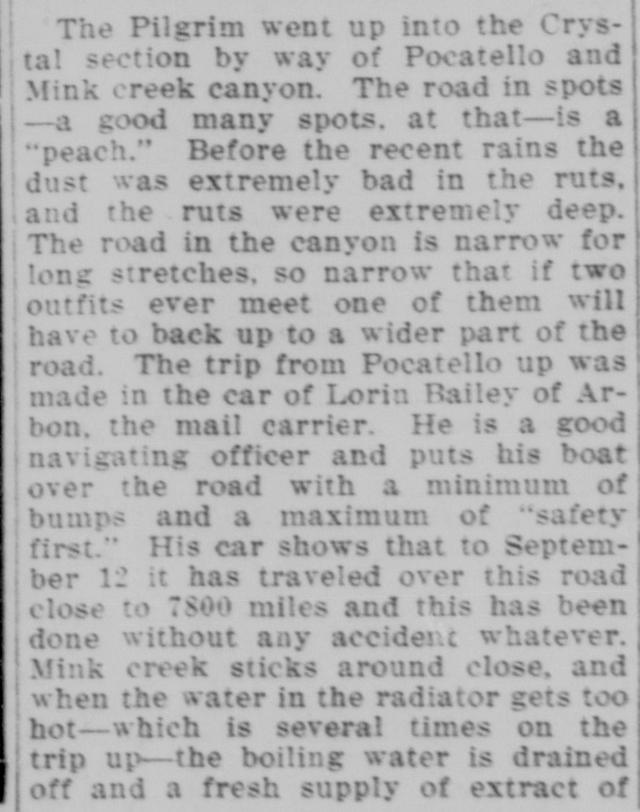
He went up to Crystal by way of Pocatello and Mink Creek canyon in the car of Lorin Bailey of Arbon, the mail carrier. In places the canyon road was so narrow that if two outfits met, one had to back up. When the radiator boiled, as it did several times on the trip up, the hot water was drained off and "a fresh supply of extract of Mink creek" put in. The winter before, in the deep snows of 1916–17, the mail had gone by sleigh behind six horses. Bailey, the Pilgrim later wrote, "beats it to Pocatello," as one of his little daughters put it, three times a week. This site counts it as probably the valley's first mail route from Pocatello.
Short cuts and roadside rests
In mid-September he took a short cut across the reservation toward Pauline and was stopped by an older Indian man, who told him quite seriously that he had to get off the reservation at once. When the Pilgrim answered that this was exactly what he was doing, the man laughed and stayed to talk, and the two smoked together for a while, the man's cigarette and the Pilgrim's old corncob pipe. The road came out near the David Daniels ranch, run by Walt and Eli Daniels, probably the sons of David Moroni Daniels, and he urged that someone photograph its old pioneer cabin.
On the Pauline road one morning he met a man hauling a load of household furniture toward Crystal.
About a mile further down the road a nice rocking chair was standing in the middle of the highway, evidently having dropped from the rear of the wagon. It is not every community that offers such a fine rest to the wayfarer; that chair came in just right for a rest and to jot down a few happenings in the note book.
In the Arbon country
By late October he was in Arbon. He had noticed that storms announced themselves with a frown on Bannock Peak, and on October 23 he reported a cold spell:
Last Monday night the old weather witch hanging out on the summit of the peak mixed a dose of winter weather and kicked the bucket over prematurely, and as a result an icy blast blew down the mountain and over the far-flung domain of the valley the following two days and nights.
Range stock was a hazard to a man on foot. One Sunday noon, about a hundred yards north of D. B. Ripley's ranch, a two-year-old heifer charged him down the middle of a highway at least sixty feet wide. He threw his hat in its face and sidestepped, and remarked that "this business of playing at being a torreador" was not in the curriculum.
Counting 312 sacks of wheat stacked in a field a few miles west of Pauline, he offered to bet "312 cents against 30 corncob pipes" that the owner was satisfied.
An old Indian man on the highway predicted an open winter, with snow two feet deep. "Here's hoping he is a true prophet," the Pilgrim wrote. On the main road south from Arbon toward Oneida County he met an Indian man and his family walking north toward the reservation. The man had been loading sugar beets into a wagon and hauling them to the factory in Utah for about $4 a day, and had quit: the wagon was too high, he said, and the beets too heavy. The Pilgrim's accounts of such meetings often carry the slighting terms papers of the day used for their reservation neighbors, and those are left out here.
Dave Lusk's three-year-old son told Mrs. Lusk that the "Program" was here. The Pilgrim thought the name not far off, since he had come "with a well defined program and carried it out." On November 13 the Arbon correspondent called him "a persistent and energetic worker." Two days later he came back to American Falls after two weeks or more in Arbon, bound next for the Rockland valley.
Back in December
By the end of November he reckoned he had visited about 200 farms across the county, and he found "the grouch and kicker is conspicuous by his rarity." He was not done with Arbon Valley:
Hiking from Pauline to Arbon one day in the sunny month of December a flivver was seen coming north, wabbling down the road like a ship on a stormy sea. It didn't look good to the Pilgrim and to prevent being charged by the wabbler he took the precaution of climbing through a fence, and still the juggernaut tried to get at him.
The driver blamed his steering gear, and then the hiker's Ingersoll watch. When Ernest Poppie wrote home from Camp Lewis with sympathy for the valley's "deep snow and cold weather," the column of January 8, 1918, answered that it was "nice and balmy in Arbon valley and all over the county." So far the winter was as open as the old man on the highway had predicted.
On this site: the Arbon and Pauline and West Fork area histories, and the Arbon stage that went into Mink Creek in 1925.
Sources
- American Falls Press, August 3, 1917, page 1
- American Falls Press, August 31, 1917, page 1
- American Falls Press, September 18, 1917, page 3
- American Falls Press, September 21, 1917, page 3
- American Falls Press, October 2, 1917, page 2
- American Falls Press, October 9, 1917, page 4
- American Falls Press, October 23, 1917, page 3
- American Falls Press, October 30, 1917, page 3
- American Falls Press, November 2, 1917, page 3
- American Falls Press, November 13, 1917, page 1
- American Falls Press, November 13, 1917, page 3
- American Falls Press, November 16, 1917, page 3
- American Falls Press, November 16, 1917, page 4
- American Falls Press, November 20, 1917, page 3
- American Falls Press, November 30, 1917, page 3
- American Falls Press, January 8, 1918, page 3
- American Falls Press, January 15, 1918, page 3