In the 1915–16 school year Lola Skartvedt taught a one-room school on Clifton Creek, in the Crystal district of Arbon Valley, and began cooking a hot noon lunch with her pupils. By the end of December the American Falls Press was telling the whole county about it.
Crystal, a high basin of springs and creeks, was School District 14 of Power County, and its area history counts five other schools there besides the Crystal Central School of 1912. In April 1914 the district called an election on $1,600 in bonds for three more schoolhouses, one of them on Clifton Creek. (A 1917 farm column placed one homestead "up on Clifton creek, two and a half miles northeast of Crystal.") The papers read for this post do not report the vote, or say whether the Clifton Creek school was one of those buildings. The Press called the school both the Clifton Creek school and the Gabbert school, and Clay Gabbert was one of its pupils.
A teachers' meeting at Pauline
On Thursday, December 9, 1915, the Arbon and Crystal division of the Power County Teachers' Association held its first meeting, at the Pauline meeting house. (The notices beforehand said December 8, but the 9th was the Thursday, as the report has it.) The trustees' wives served a picnic dinner. County Superintendent Madge Whistler and County Agent Kjosness came out, with teachers from Crystal, Valley View, Bannock Center and Pauline and several Crystal school patrons. Among the talks, Kjosness spoke on the "Rural High School," which the paper said was just then the big topic in the valley, and Miss Whistler explained a plan to give pupils school credit for chores done at home.
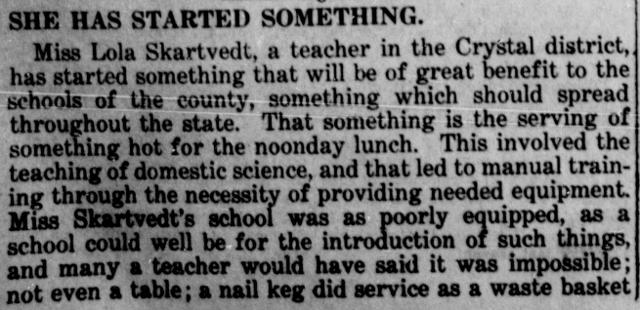
Lola Skartvedt's paper was called "City School Features Adapted to Rural School Needs." The report said she had made "a bare shack school" in the Clifton Creek community into a lively one, and the headline over it called the Crystal school, apparently meaning hers, "the First Rural School to Include Manual Training and Domestic Science." The Press printed her paper on December 23, and a week later its editorial page took up the subject:
Miss Lola Skartvedt, a teacher in the Crystal district, has started something that will be of great benefit to the schools of the county, something which should spread throughout the state. That something is the serving of something hot for the noonday lunch. This involved the teaching of domestic science, and that led to manual training through the necessity of providing needed equipment.
The editorial and the meeting report described what she had to work with. There was not even a table. A nail keg "did service as a waste basket," and with a board over it served as a seat for one of the larger pupils. The stove, "minus three legs," stood propped on stones from the creek.
In her own words
Her paper tells how the lunches began. Watching her pupils "gulp down their food and wash it down with cold water," she found them listless and hard to manage, so she asked them to talk over something hot at noon with their parents. All of them wanted it. The pupils formed a Domestic Science Club, with a boy as president and a girl as secretary and treasurer, and two of the mothers joined the teacher as advisers. Each child paid ten cents toward a stock of provisions, and ten cents more when it ran out; the president did the buying and the secretary kept the accounts. Every Friday the menu for the coming week was made out and cooks were appointed, two for each day. "Even the boys have their turn." She described how they had managed at the start:
The first month we borrowed a kettle and often had to borrow dinner pails, using the wash basin for a double cooker, and the first week we used the floor as a table. Now I have a kitchen table made by two of my boys during recess, noons and after school hours.
A lady who was not a patron of the school gave them a kettle and a can opener, and the pupils brought the dishes, so the whole outfit cost fifty cents. The buying became a lesson of its own: a quart of milk at eight cents, she taught, held as much food value as a quart of oysters at sixty-five. Cooking led to sewing: dish cloths, dish towels, holders, caps and aprons. Two of her eight-year-old boys made aprons, and one of them, she wrote, had his heart set on becoming a "restaurant man." For the older boys the tools came from home, and the table the two boys had built, using the porch as a workbench, now served for both cooking and manual training.
The rest of the winter
At Christmas her pupils served a dinner to the school's patrons, decorated in red and green; the school note said they had learned correct table service and etiquette in order to prepare and serve it. In January, Clay Gabbert earned four marks of 100 at the Clifton Creek school's mid-year examination.
Late in January Miss Skartvedt came in from the Crystal district for the county teachers' and trustees' meetings at American Falls. The school notes from those meetings reported that she was still serving warm lunches and gave credit at school for work done at home, and that "cleanliness is one of the indispensables in her school." A young German interested in her work had given the school "a carpenter bench and a set of the most necessary tools," and she and the boys were building a doll house. Olive Beale of the Crystal school had taken up the warm noon lunch as well.
In May 1916 Lola Skartvedt passed through American Falls on her way home to East Stanwood, Washington. The Press explained why she would not be back:
Miss Skartvedt had some most flattering offers if she would accept the same position for next year, but a Washington city has offered her the supervision of the domestic science and art work. She is so eminently well qualified for this that scarcely a rural school in all Power county could afford the salary she is able to command.
The papers read for this post do not follow her after she left, or say who taught the Clifton Creek school next.
On this site: the first schools at Crystal, Pauline and West Fork, where the teachers met, and the schools of Arbon Valley.
Sources
- American Falls Press, April 9, 1914, page 2
- American Falls Press, November 25, 1915, page 1
- American Falls Press, December 9, 1915, page 1
- American Falls Press, December 23, 1915, page 6
- American Falls Press, December 30, 1915, page 2
- American Falls Press, January 6, 1916, page 2
- American Falls Press, January 27, 1916, page 4
- American Falls Press, February 3, 1916, page 3
- American Falls Press, May 11, 1916, page 2
- American Falls Press, November 2, 1917, page 3
- Jacob Andersen, "Crystal," area history on this site