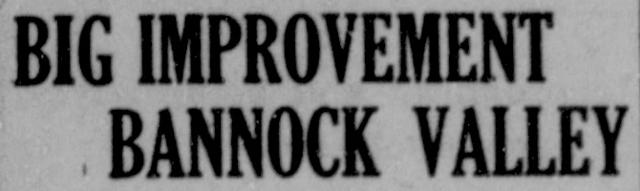
On Saturday, March 28, 1914, a railroad promoter, probably M. A. Patton of the Double-P Construction Company, spoke to what the Arbon correspondent, Mrs. E. A. Logan, called "a large crowd of people at the Central school building" and asked the valley for a right of way. Patton's line was to run on a single track of timbers and strap iron set on a row of posts, with the cars hanging astride it. Arbon Valley, then often called Bannock Valley, had passed from Oneida County into the new Power County in 1913, and it had no railroad.
Twenty-five cents a hundred
The valley's wheat went out by team. In September 1913 the American Falls Press put the cost of getting a crop to the railroad at about twenty-five cents a hundred pounds. Much of the grain went to the railroad siding at Michaud, six miles from Pocatello. George Andersen remembered in his life story that a trip with grain to Michaud or to Malad took three days.
In March 1913 W. E. Dawson, writing for the Arbon Commercial Club, told the Press that the valley was "a splendid field for an electric line." In January 1914 the Logan Republican, reporting a visit to Logan by Bishop W. F. Kowallis of Meadow Ward, wrote that some farmers hauled their grain twenty-two miles to market and that "A railroad is expected within a few years."
The book and the pencil
On April 9, 1914, the Press reprinted in full on its front page a Pocatello Tribune account of a meeting of the valley's boosters at Arbon. It opened: "A railroad in Bannock valley in the next hundred days instead of the next hundred years is the slogan of the United Bannock Valley Booster association." The railroad on offer belonged to the Double-P Construction Company:
M. A. Patton, president of the Double-P Construction company which seeks a right of way for the building of a line and equipping it with its system of cars, explained the merits of his invention in a very simple manner. Taking up a small book, he placed it astride a pencil, citing that the pencil, might represent the track and the book the car.
The track would stand three feet above the ground and be a foot wide, on posts eight feet apart. "The car hangs astride the track and loaded about equally on both sides, the load hanging below the track. The car cannot jump the track." Patton would run trains of a dozen or more cars with a 30 or 40 horsepower automobile engine at each end, at about ten miles an hour. He could haul grain for about five cents a hundredweight and make a profit, he said, saving the valley about $48,000 on 300 cars against the twenty-five cents farmers were paying.
The promoter "replied to vigorous questioning." The meeting voted the company a right of way and named a committee of three to confer with it. More than two dozen men, "all of Arbon," signed a resolution favoring the right of way and the bonding of their district at $1,000 a mile, taken as stock in the company, on condition that it haul their grain to the railroad for no more than five cents a hundred pounds. D. J. Bowen, W. E. Dawson, G. M. Houk, J. J. Infanger, Sam P. and W. P. Roderick and Paul A. Smith were among the names, and William Allard signed as the boosters' secretary. The boosters' president, whom the story does not name, put it this way: "We have done all we could, and we have not been able to prove that Mr. Patton cannot do all he promised."
Mrs. Logan's short account, reprinted by the Press on April 30 from the Sheep Store News, is probably of the same meeting, though the speaker's name cannot be read in the digitized text. In her account he estimated the line would cost near $1,000 a mile, the figure the Pocatello account gives as the farmers' pledge of stock, and she ended: "If such a line can be built it will be a great help to Bannock valley farmers."
Where the line would run
Where the line would end depended on who told it. Mrs. Logan gave its terminal point as Michaud. The Pocatello account had the boosters working to "speedily connect them with the Gate City," as Pocatello was called. Pocatello reports in the Ogden Daily Standard said the right of way was granted "providing the company can make good on its claim," and that the Arbon valley people wanted an interurban to Pocatello "right away instead of several years from now." The Pocatello Commercial Club set a conference on the project for April 16. On April 6 the Salt Lake Telegram, under the headline "This Railway Will Hang from Poles," found Patton, of Idaho Falls, in Salt Lake City interesting businessmen in his patent. The first such road, thirty miles of it, would be built in Bannock Valley that summer, he said.
The Press was published at American Falls, the Power County seat. It printed the Pocatello story within a front-page article that also reported a telephone line and six-day mail service projected for the valley, under a subheading promising to bring the valley "Into Closer Touch With the County Seat." Two weeks earlier it had written of making American Falls "the center of the richest agricultural section in this part of the state."
What came of it
No report has been found of what the April 16 conference decided, of the committee's work, or of the Double-P company after Patton's visit to Salt Lake City. In June a Pocatello real-estate company advertising lots in the Salt Lake Tribune still pointed to "the proposed Arbon valley interurban electric line which is now negotiating for franchise to electrify this road," the county road to "the famous Arbon valley." Whether that was Patton's line or one of the other plans talked of that spring is not known. On October 15, 1914, the Press reported: "Grain hauling is at its height from the Arbon country now. Most of it is being received at Michaud siding."
At the end of 1915 a Pocatello traction company planned to send engineers to survey a line into the valley, and a railroad project revived in 1916 was set aside the same year as too costly to build. When the Deseret News printed Andrew Jenson's history of the Arbon Ward in 1935, it still gave American Falls, forty miles away, as the nearest railroad station.
On this site: the first trucks and the first grain warehouse follow the valley's wheat to the railroad in later years, and the Allard family album holds William Allard's homestead patent, issued that same March.
Sources
- American Falls Press, November 23, 1911, page 1
- American Falls Press, March 20, 1913, page 7
- American Falls Press, September 11, 1913, page 1
- American Falls Press, September 11, 1913, page 8
- Logan Republican, January 15, 1914, page 4
- American Falls Press, March 26, 1914, page 6
- Ogden Daily Standard, April 3, 1914, page 12
- Ogden Daily Standard, April 4, 1914, page 18: "Want Interurban Line"
- Ogden Daily Standard, April 4, 1914, page 18: "Active in Business Harness"
- Salt Lake Telegram, April 6, 1914, page 14
- American Falls Press, April 9, 1914, page 1
- American Falls Press, April 30, 1914, page 1
- Salt Lake Tribune, June 21, 1914, page 22
- American Falls Press, October 15, 1914, page 5
- Ogden Daily Standard, December 31, 1915, page 8
- Salt Lake Tribune, October 1, 1916, page 14
- Deseret News, April 24, 1935, page 4