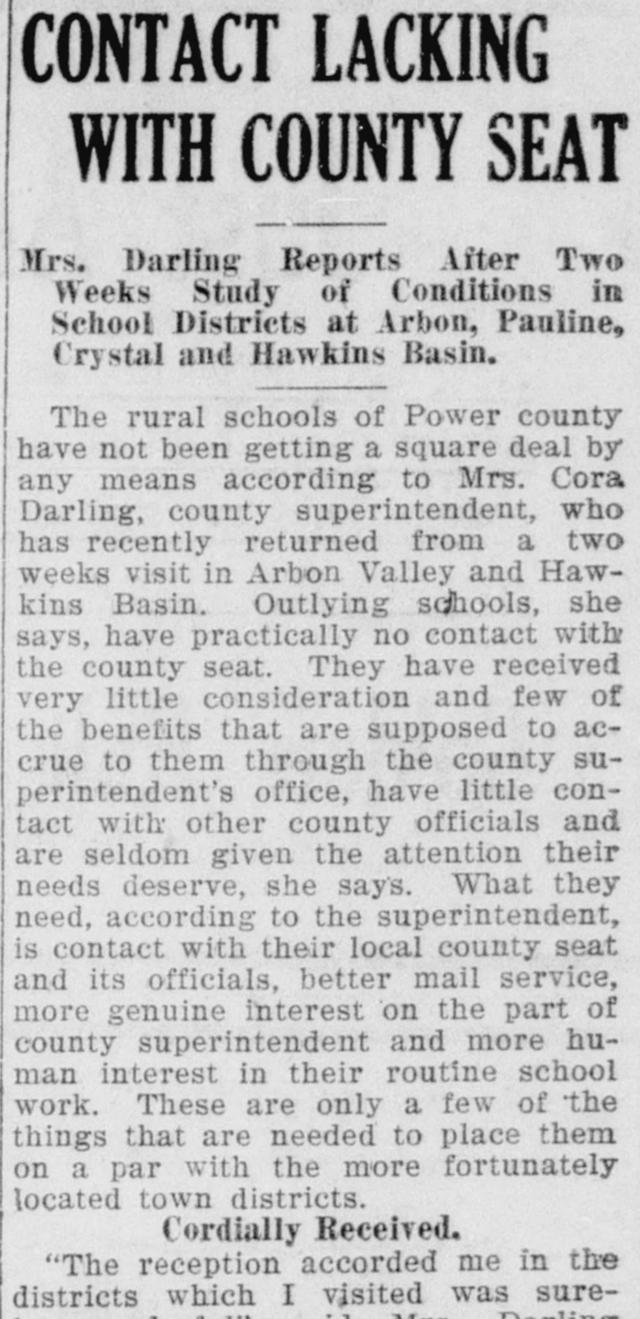
In the second half of October 1923, Mrs. Cora Darling, Power County's superintendent of schools, spent two weeks visiting the country schools of Arbon Valley and Hawkins Basin, sometimes riding from one to the next on a grain rack. The American Falls Press reported her trip on November 1, 1923, under the headline "Rural Schools Haven't Received Square Deal."
The valley had been in Oneida County until 1913 and in Power County since, and its schools answered to the county superintendent at American Falls. Mrs. Darling, in office since January, said the outlying schools had "practically no contact with the county seat" and needed better mail service and "more genuine interest on the part of county superintendent."
Two weeks in the valley
She wrote ahead to the school boards, took the train to Arimo and the stage to her first school, in Hawkins Basin, about twelve miles southeast of Crystal. She visited:
- the Lyon school, District 26, taught by Miss Helen Butler
- the Blair and Crystal schools, District 14, taught by Elmer J. See and Lelah Nelson
- the Armstrong school, District 6, taught by Miss Rosa Sack
- the Pauline school, District 13, taught by Chester Smith and Miss Marion Sparks
- the Arbon school, District 12, taught by Miss Susie Cox
- the Valley View school, District 11, taught by Joseph Rytting
Now and then a farmer drove her around in a car, and once in a while, the paper said, "she walked two or three miles rather than have anyone stop harvest to take her around."
Some of the schools, she said, had not seen a county superintendent in two years; others had been visited "about 15 minutes once during the year." She had announced that she planned to stay a day or two at each school, and afterward told the Press:
I lived right with the people in the districts two weeks and I found what was really in their hearts and heads concerning their children and their schools. Their schools seemed to be of the greatest interest to them and there was nothing that they would not do to aid me in getting the information I wanted or in imparting the information I went to give.
Two days at Pauline
On Friday, October 26, she met the teachers at Pauline to talk over school problems and methods around the table. Some of them said it did more good than an institute, the usual training gathering for teachers. That evening the community came in for a dance.
Saturday was given to a community meeting for parents, children and teachers. Mrs. Francis M. Wann, a nurse sent out by the State Tuberculosis Association, came out from American Falls with Miss Maud Ayres, a primary teacher. Mrs. Wann weighed the children and gave their parents charts showing what to feed those who were undernourished. The paper's account went on:
A big dinner was then served by the teachers assisted by the students of the upper grades. The food was furnished by the mothers present. The meeting was so successful that the visitors were asked to stay another day. Mrs. Darling and Miss Ayres could not stay but Mrs. Wann consented to stay as long as there was a need for her in the community.
The trip cost Mrs. Darling $16.90 for the first week and $33.30 for the second, nearly half of the second week's cost going for the livery hire that brought Mrs. Wann from American Falls to Pauline. The school patrons wanted to put her up free of charge, but she "felt as though she should pay her way as she went."
What followed
In the same issue the Press began mailing itself free each week to thirty-one rural schools. Pupils were to write news for it as a weekly language lesson, printed "identically as written." The Pauline children's column that winter is how the site knows of their first radio, heard at the Allard home in December.
On November 8 the paper described the Pauline school's mornings. Chester Smith, "a late soldier with an over seas record," and Miss Sparks taught there. Each day began with the pledge of allegiance: a primary pupil who had earned honors the day before stood on a small platform holding the flag, and at a signal the pupils recited the pledge together; the children ended it with "I Salute Thee" and a salute, and fifteen minutes of music followed. Mrs. Darling held up District 13 as "setting an example she would like every school in the county to follow."
After Mrs. Wann had spent two days in the Pauline school, the pupils were tested on their health chores and on adenoids, and asked, "What per cent are you under weight, over weight or are you a star." In December Mrs. Wann judged forty per cent of the county's school children undernourished, and a county anti-tuberculosis association was formed to sell Christmas seals, with "Mrs. John Kowallis of Arbon valley" among its vice-presidents.
In May 1924 the Arbon school, taught by Miss Susie Cox, won the first Modern Health Crusade banner ever to come to Power County, one of the valley's firsts. The Press said:
That is a real achievement—a greater one, we are told, than obtaining high average in the class room and graduating with honors. Modern educators say health is the first factor in the development of the boy or girl. If Arbon school had done little else than win a health banner it would have been successful.
A news note printed in the Filer Record, the Oakley Herald and the Challis Messenger added that the county's pennant "helped put Idaho in fifth place among the states of the nation." No paper says whether the nurse's visit had any part in the win.
Back in 1925
Mrs. Darling inspected the valley's schools again in October 1925 and found its people "very much aware of the value of good rural schools." The Valley View school had no water, and no barn for the pupils' horses. At Crystal some children lived seven miles or more from the schoolhouse. They had come the year before, "but the exposure and discomforts were too great," so a temporary winter school was to open for them in early November.
When she died at Pocatello in 1951, the Twin Falls Times-News noted that she had been superintendent of Power County schools.
On this site: the first schools at Pauline and Crystal; the histories of Crystal and Pauline and West Fork; and the Schools of Arbon Valley.
Sources
- American Falls Press, January 4, 1923, page 5
- American Falls Press, November 1, 1923, page 1
- American Falls Press, November 1, 1923, page 8
- American Falls Press, November 8, 1923, page 1
- American Falls Press, November 15, 1923, page 5
- American Falls Press, December 6, 1923, page 1
- American Falls Press, May 22, 1924, page 3
- Filer Record, May 29, 1924, page 2
- Oakley Herald, May 30, 1924, page 2
- Challis Messenger, June 4, 1924, page 2
- American Falls Press, September 17, 1925, page 4
- American Falls Press, October 29, 1925, page 1
- Times-News (Twin Falls), July 6, 1951