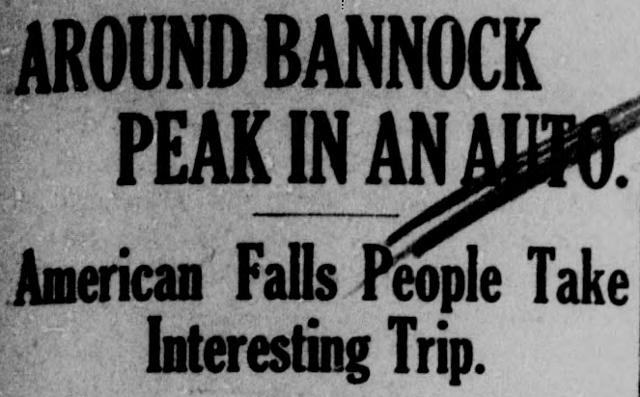
On Sunday, July 16, 1911, four men from American Falls drove 127 miles in a single day around Bannock Peak. They went south by Rockland and Holbrook and came home north through the Arbon country. Four days later the American Falls Press told the story on its front page, beside two photographs of the valley.
Bannock Peak is the highest mountain overlooking the valley, as the site's history of Joseph Arbon describes it. The Press called it "the sentinel" for travelers "across the plains since the days of the overland trail." Only two weeks earlier it had reported a party from Aberdeen and American Falls that camped at the foot of the peak and climbed it. A good many people had climbed it, the paper said, "but few have gone around it in a single day."
The party and the road out
The car belonged to D. W. Davis, very likely the president of the First National Bank of American Falls. With him rode Arthur W. Davis; O. H. Barber, the manager of the Press; and a fourth man whose name the digitized page garbles. Neither Davis is known to be related to the Davis family of Arbon. It was not the first car to reach the valley; the Firsts page dates the earliest on record to the end of 1910.
The party left at 6 a.m. and was home at 7:45 p.m. It passed through Rockland "before breakfast time—for Rockland people" and found the Holbrook road too high in the center for automobiles. At A. B. Reece's place, "the first place across the divide from Landing," thirty-eight miles out, the men spent fifty minutes taking pictures and mending a puncture. Beyond it they drove three miles of new road, theirs the first vehicle over it, and came on to Holbrook, a little over thirteen miles past Reece's.
Dinner on a well trough
Here the digitized text is jumbled, and the stretch of road after Holbrook is lost. When the story picks up again, the party seems to have entered the Arbon country at its south end, and the men are at dinner:
The table was set on the water trough of a new well 350 feet deep, and an elegant spread consisting of 4 cans of sardines, twelve egg sandwiches, a can of peaches and a dozen oranges and forty cents worth of cake taken care of in record time. It was only a light repast, yet the gentlemen felt called upon to politely decline invitations to stop and have dinner four times within the next two hours.
"Funny how one's appetite fails when traveling," the paper added.
As the dishes were being put away, Mrs. Walker came by and asked whether they needed anything. They wanted only a road going their way, and she guided them to the main road. About a mile on they found the Walker brothers, who "had lost their almanac and were shingling a house, confident in the belief that the day was along about the middle of the week." It was Sunday. The Walkers had brought a traction engine and gang plows into the valley, and they ran a blacksmith shop that was "much appreciated by their neighbors." The paper gives no first names, so which Walkers these were is not known. The party took two pictures at the Walker places.
The next stop was the home of W. A. Nunnelly, probably Walter Albert Nunnelley of Summit, who was away in Malad. "During his absence another picture was added." By the family's own account, Joe Arbon had brought the Nunnelleys hay, and Ed Davis groceries, in their hard first winter.
Calling on the pioneers
From there the party took the road due north, past what the paper called numerous fine fields, among them that of E. H. Davis, which was "particularly good." Then it made a brief call:
A short call was made on Joseph Arbon, the pioneer of the valley, who has been a resident of that beauty spot for near fifteen years. He has seen greater changes during the last two years however, than in all the others that have gone before.
This was probably George Arbon's son Joe, and "near fifteen years" points to about 1896, close to the family's accounts of their first winters.
Next came John Payne, George Arbon's son-in-law and "the pioneer store keeper and hotel man." The paper said Payne had 320 acres, nearly all of it in cultivation, with water for about forty acres, "one of the best places in the valley." He estimated that 150,000 to 200,000 bushels of grain would be hauled out of the valley that fall. The words "hotel man" bear out the Firsts page, which records the valley's first hotel by March 1911 and judges that the Paynes probably kept it.
"A stop was taken at the school house long enough to take a picture of it." Then came a call at the home of Tom (T. B.) Evans, who was "said to have more land in cultivation than any other man in the valley." After leaving the valley, the party followed the Pocatello road as far as the pole line and made good time home.
The writer's verdict: "The Arbon country was the most beautiful of any seen on the trip, and the development there was fully as great as that of any other section."
The article added that people there were much interested in the new road that had been surveyed to American Falls, which would shorten their haul to market. "The marketing of their grain is a growing problem."
The wheat and the pictures
The same front page carried a report on the coming harvest. Four new settlers, G. S. Butler, John Butler, G. W. Allard and Mr. Keeler, were expected to market 25,000 bushels of wheat. Three years earlier, "when the valley contained about forty families," the whole yield had been estimated at 45,000 bushels, and estimates for 1911 ran as high as 200,000. With a little more time for development, the paper predicted, the Arbon country would be "capable of marketing a million bushels" a year.
Two photographs ran on the same page, probably taken on the trip, captioned "View in the Arbon Country, From T. B. Evans' Place" and "Dry Farm Grain Field in the Arbon Country." The other pictures have not turned up in the later 1911 pages read for this post.
On this site: the Joseph Arbon page tells how, in the summer of 1965, he rode a horse to the top of Bannock Peak to celebrate his approaching ninetieth birthday; the Evans and Davis pages tell more about the farms the party passed.