By June 1920 the dry farmers of Arbon Valley had pledged most of their coming wheat crop to a new cooperative, the Oregon, Washington and Idaho Wheat Growers Association, which would sell their grain in a pool instead of each man selling on his own. The American Falls Press, the paper of Power County (Arbon had been in Oneida County until 1913), followed the valley's part from a hopeful spring into a hard winter.
A good spring
The year before had brought the drought of 1919. In 1920 the rain came. After a soaking Sunday rain late in May the Press said it came close to "a million dollar rain," and went on:
The Arbon and Rockland valleys are beautiful beyond description. An even stand of grain decorates the valleys with a waving coat of green. General conversation now centers on the price of grain rather than the prospects entertained for a crop failure.
The Arbon correspondent reported that "there is more water this year than the ditch will hold." On June 18 the front page called Arbon Valley the one section of the county not short of moisture and predicted 25 bushels to the acre there even if the summer stayed dry.
Signing up
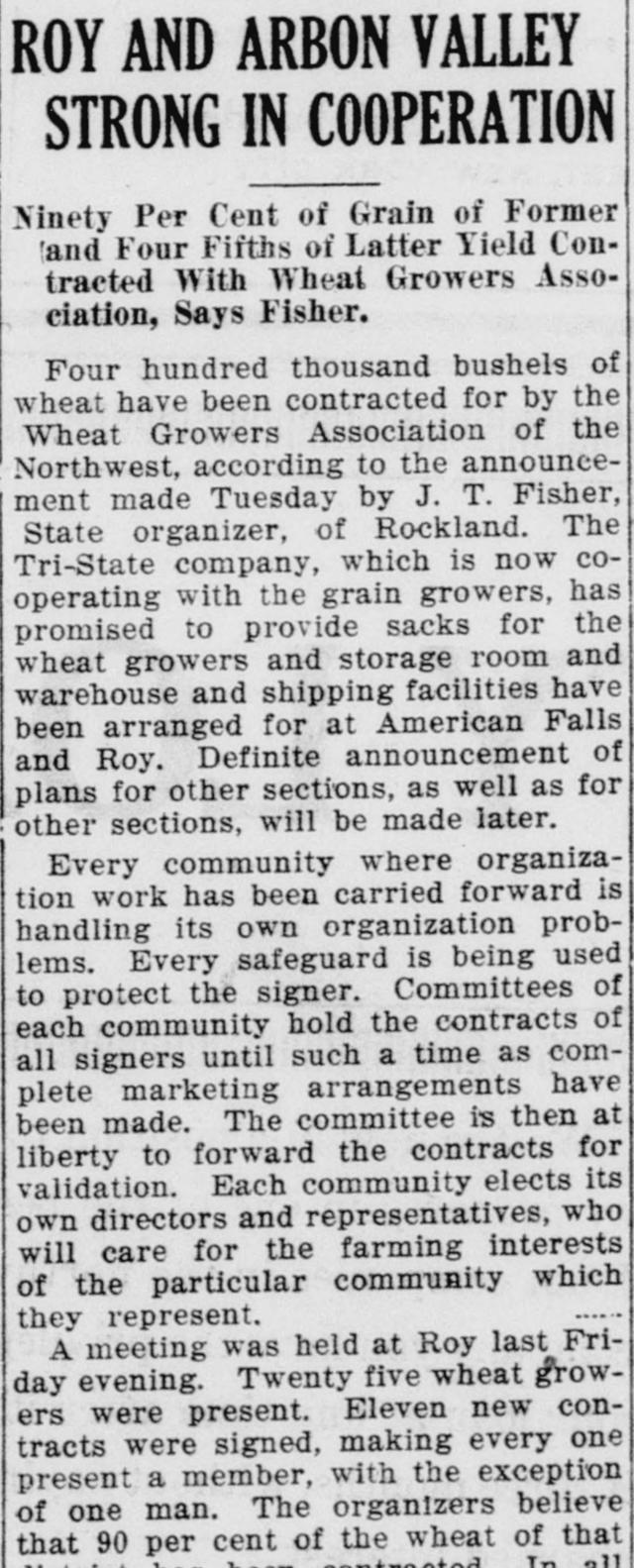
The price was the worry, and the association offered an answer: members would put their wheat under contract and let one organization sell it. Its state organizer was J. T. Fisher, president of the Rockland State Bank, and the county agent, Bruce Lampson, spent a few days in Arbon in May on its business. On June 18 the Press reported, on Fisher's word, that 400,000 bushels had been contracted with the association, and Fisher singled out the valley:
Arbon Valley has gone strong for the Wheat Growers Association, according to Mr. Fisher. Out of an estimated yield of 200,000 bushels in 1920, the Wheat Growers have been promised 161,000 bushel. This is practically 80 per cent of the total production of the valley.
A week later the Arbon column named the valley's committee, W. E. Dawson, W. A. Nunnelley and Wm Allard, who had been "securing many signers." Dawson lived at Pauline; Nunnelley was probably Walter A. Nunnelley of the Summit homestead family; and William Allard, who had homesteaded on Knox Canyon Road in 1909, had sat in the Idaho House in 1915 and 1919–20 (see the first legislator from the valley).
In July Allard went to Spokane to confer with the association's officials "for the interests of the Arbon farmers," and came home having met with its directors "as one of the representatives of Power County." On August 6 the Press reported the association ready to do business: Lampson was leaving his county post to organize for it, contracts for 325,000 bushels had been accepted, and "Platforms will be built immediately at Arbon and Roy." Whether a loading platform was ever built at Arbon, the pages read here do not say. The valley's pooled wheat was hauled to the association's platform at Michaud.
A rainy harvest
On August 6 the Arbon column reported new combines in the valley and J. E. Keeler combining volunteer wheat, and the correspondent wrote, "It appears it will be a rainy harvest." On August 13, using the valley's old name, the column reported:
Bannock Valley has been visited the past week with quite a number of heavy rains, delaying the harvesting for about a half a day at a time nearly every day. Thursday we had quite an electrical storm, tearing down the telephone line in a few places. No serious damage has been reported. Due to the rains and the breaking of combine parts, the farmers are kept pretty busy these days trying to get their grain cut and making trips to Pocatello for extras.
The grain was averaging 18 to 20 bushels an acre, with some fields higher.
On Monday, August 16, the association sent off two cars bound for Galveston, Texas, the first of a 40,000-bushel export order, at a price of $2.42 a bushel at American Falls. Members received an advance of $1.80 a bushel, and a Malad farmer was reported asking to join after being paid only $1.76. Whether any Arbon wheat was in that shipment is not stated. By mid-September Charles Palmer, out from Pocatello with a large truck, was "extra busy hauling grain to the Association platform at Michaud," and on September 14 wheat prices broke sharply at Chicago.
A long winter
A blizzard came on Thanksgiving Day. On December 3 the Arbon column reported trucks hauling to Michaud again over frozen roads and much grain still unthreshed: "The steam thresher works when the weather permits, which is not very often these days." A week later the Burnside Brothers of Pocatello had their large trucks in the valley "hauling the Association Grain," and on December 17 the column reported, "Threshing is delayed again."
On December 2 Allard attended the directors' monthly meeting in American Falls. The local market was paying $1.90 a hundredweight for Turkey Red wheat, about $1.14 a 60-pound bushel, which the Press noted was twenty cents a bushel above the year's low. In January a local grain dealer urged households to buy flour by the barrel to help farmers who had been getting "less than the cost of production." In March the county agent said that much land in Power County had lain ready since fall with no wheat sown, because farmers could not buy seed: "They had no money." In early May trucks were still moving "the balance of the Wheat Growers Association grain to Michaud" out of Arbon.
1921
On May 16, 1921, Allard, Keeler and B. D. Lindley of Arbon were at Pocatello when a touring committee of the U.S. Grain Growers met farmers of southeastern Idaho; the Press counted only two votes there against compulsory, 100 per cent pooling of grain. That week its front page printed Allard's photograph, with those of H. D. G. Cox of Roy and Fisher, by then a state senator, under the heading "These Men Are Doing Their Bit." At the annual meeting of what was now the Southern Idaho Wheatgrowers Association on June 25, a new board was chosen: "Retiring members of the board are Wm. Allard of Arbon and H. D. G. Cox of Roy." The paper did not say why.
What the pooled Arbon wheat of 1920 finally brought its growers, the pages read here do not show. The years that followed brought the foreclosures of 1920–1925, when farmers who had mortgaged their homesteads in the high-price years could not pay. In 1933 Allard chaired the committee that organized the Arbon Valley Grange.
Sources
- American Falls Press, May 28, 1920, page 2
- American Falls Press, May 28, 1920, page 4
- American Falls Press, June 18, 1920, page 1
- American Falls Press, June 25, 1920, page 6
- American Falls Press, July 2, 1920, page 1
- American Falls Press, July 16, 1920, page 3
- American Falls Press, July 23, 1920, page 9
- American Falls Press, August 6, 1920, page 1
- American Falls Press, August 6, 1920, page 2
- American Falls Press, August 13, 1920, page 8
- American Falls Press, August 20, 1920, page 1
- American Falls Press, September 17, 1920, page 1
- American Falls Press, September 17, 1920, page 2
- American Falls Press, December 3, 1920, page 1
- American Falls Press, December 3, 1920, page 2
- American Falls Press, December 10, 1920, page 7
- American Falls Press, December 17, 1920, page 4
- American Falls Press, January 7, 1921, page 5
- American Falls Press, March 18, 1921, page 1
- American Falls Press, May 6, 1921, page 2
- American Falls Press, May 20, 1921, page 1
- American Falls Press, May 27, 1921, page 2
- American Falls Press, July 1, 1921, page 1