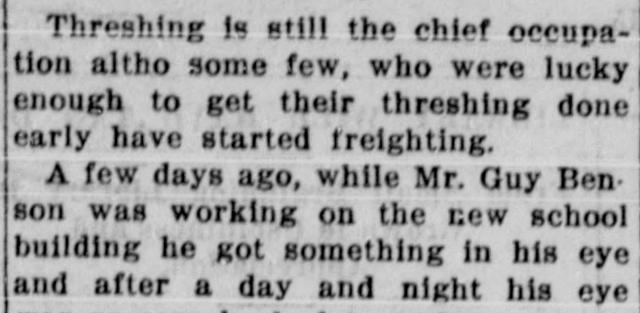
In 1915 the dry farmers of Arbon Valley, south of Pocatello and American Falls, who grew their grain without irrigation, planted more wheat than ever, brought in a good crop of fall wheat and cut part of it with the valley's first combine harvesters. The American Falls Press, published at the seat of Power County (Arbon had been in Oneida County until 1913), followed the season in its Arbon and South Arbon columns and in news from Crystal.
Two solid townships
On November 26, 1914, G. S. Randall of Arbon told the Press there would be "at least two solid townships of wheat grown by Arbon and Crystal farmers next year." A survey township is six miles square, about 23,000 acres, and Randall counted not less than 46,000 acres seeded or ready for spring seeding: more than a million bushels at about 25 bushels an acre. "Six or seven years ago," the paper added, "there was scarcely any grain grown there, the few settlers devoting themselves to stockgrowing."
The fall of 1914 was dry, and in December Henry Shandrew of Arbon said "fear is felt for fall wheat." The spring of 1915 was dry too. On April 22, 1915, the Press reported that farmers were rejoicing over "splendid rains of the past few days"; only twice in fifteen years, in 1900 and 1910, had a spring been so dry. Arbon and Crystal had "a thorough soaking." In mid-May Randall said "crop prospects never were so good," and on June 3 the South Arbon column reported, "The spring rains continue and the crops are looking fine. They are a month earlier than usual."
The first combines
Until then the valley's grain had been cut with headers, which clipped off the heads for stacking and later threshing. A combine cut and threshed in one pass, and by July 1915 the Press counted about 150 of them in Power County.
The earliest Arbon combine found in the papers belonged to G. M. Houk and W. E. Fisher. On May 20, 1915, the Press noted that the two men "were in Monday after a header for their combine." It does not say when they got the machine.
On June 24 the North and Central Arbon column reported that F. J. Lewis, a salesman for the North Western Harvester Co. of Spokane, had spent several weeks in Arbon selling combines. Humphries, E. A. Logan, Hill and Messenger had bought a combine together, and the Stotts and Lees of South Arbon another. The column said the grain could hardly all be saved with headers alone. That report is the source of the site's entry on the first combines; the Houk and Fisher item puts a combine in Arbon hands five weeks earlier.
Harvest
The same June 24 paper reported that two men who drove through the Rockland and Arbon valleys found the spring grain badly needing rain, though the fall grain was little hurt.
Harvest began around Arbon at the end of July. Marshall Johnson drove through the valley and saw "several fields of grain that will yield forty-five bushels to the acre," and on August 5 the Press reported, "Arbon and Crystal have some splendid fields and the average there will be very high." A week later the Blewett combines were doing fine work, several more had been bought, and E. H. Davis was busy freighting supplies to his store, "as every one is busy harvesting."
Across the county the Press judged most spring-sown grain a failure. At the south end, around Summit, frost had done considerable damage, "but not nearly so much as last year," and some people were cutting their spring grain for hay, though most of the fall grain was good.
"Men have been scarce this season," the South Arbon column reported in September, and several crews had started short-handed. The new combine had its troubles: "The Lee brothers and Tom Stott started their combine last Monday and had a breakdown the first thing and have been having all kinds of bad luck since." The next week's column reported that Stott's overalls had caught on a set screw on the combine; his leg was badly bruised, but he went back to work. The partners finished their crop with the combine by mid-September.
"Most of the heading is over and threshing is in full blast, crops are turning out good," the column reported on September 9. Thomas King and his sons brought a new threshing machine home from Malad, and Mr. Nunnelley finished sawing and moved his engine down to thresh. A week earlier, J. W. Phillips of Crystal had reported "one small field giving 65 bushels per acre."
Fire and freight
After several fires in early September, which burned a lot of fence but little grain, the correspondent wrote on September 16:
Some one set a fire on the west side of the valley about a week ago that came near burning Mr. Fred Larsen's crop and buildings. There was quite a strong wind and Mr. Larsen and Mr. Homer Young had to fight fire for almost half a day to save his place. The grass and sage brush are so dry that it is almost impossible to stop a fire when it once gets started.
Then the grain was hauled, over the mountain to Malad or across the Fort Hall Reservation, where the roads were "nearly impassable for those freighting grain." The same issue showed how many hands the harvest needed:
Mr. Edd Hooker butchered a two year old steer the first of last week but had no trouble in disposing of it around in the neighborhood as most every family has a crew of men to cook for.
Late in September hard rains stopped all farm work at the south end. On October 7 the South Arbon column reported that the Sorenson brothers' threshing machine had had "an explosion one day last week, caused by smut," one of the smut explosions at threshing time, though they were back at work within hours.
What it came to
No count of the 1915 crop has been found to test Randall's forecast. On January 2, 1916, the Salt Lake Tribune called the Arbon valley "a tract of 100,000 fertile acres, one-half of which is in wheat," growing about a million bushels a year, most of it handled through Pocatello. That was a yearly figure, not a count of 1915. In February 1916 G. M. Houck, as the Press spelled the name, probably the same G. M. Houk, drove "the first vehicle out of Arbon since winter began" and sold the wheat he had stored to Adolf Claassen at American Falls for $1.00 a bushel.
On this site: the first threshing machine at the south end, the June frost that killed George Andersen's wheat and the history of Arbon.
Sources
- American Falls Press, November 26, 1914, page 1
- American Falls Press, December 3, 1914, page 5
- American Falls Press, April 22, 1915, page 1
- American Falls Press, May 20, 1915, page 5
- American Falls Press, June 3, 1915, page 4
- American Falls Press, June 24, 1915, page 1
- American Falls Press, June 24, 1915, page 8
- American Falls Press, July 29, 1915, page 1
- American Falls Press, July 29, 1915, page 5
- American Falls Press, August 5, 1915, page 1
- American Falls Press, August 12, 1915, page 4
- American Falls Press, September 2, 1915, page 5
- American Falls Press, September 2, 1915, page 8
- American Falls Press, September 9, 1915, page 2
- American Falls Press, September 16, 1915, page 2
- American Falls Press, September 30, 1915, page 6
- American Falls Press, October 7, 1915, page 1
- Salt Lake Tribune, January 2, 1916, page 57
- American Falls Press, February 10, 1916, page 5