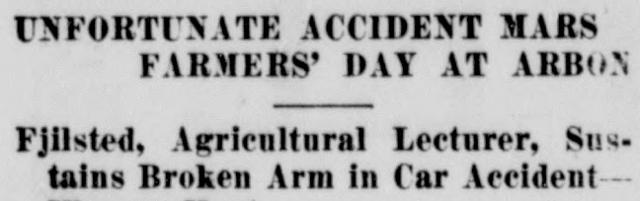
On Wednesday, May 10, 1916, the valley held what its correspondent called "our first fair," a farmers' day and community fair at the Central school in Arbon. The American Falls Press reported the exhibits, the speeches and an accident that hurt two people, and three weeks later William Allard's sharp answer to an unsigned critic.
Arbon, in Oneida County until 1913, was by then in Power County, run from American Falls. The new county's agricultural agent, A. W. B. Kjosness, and its school superintendent, Madge E. Whistler, encouraged the fair.
A fair day for Bannock Valley
In January 1916 Kjosness said he was encouraging community fairs whose winners would go on to the county fair. In early April, speaking to the valley's literary society, he suggested that the Bannock Valley farmers hold a fair day, presumably soon after school closed, "the farmers bringing their best in the line of stock." The Press of April 27 listed a series of five fairs, Crystal's first and Arbon's on May 10. The Arbon committee was William Allard, J. D. Dawson and a third member printed only as "Bishop Arbon."
The day at the Central school
"A fair crowd was out considering the busy season and disagreeable weather," the correspondent wrote. Visitors from American Falls included the school band, Senator D. W. Davis and Dr. Noth.
Mildred Warren of the Pauline school and Claudia Cox, who evidently taught with Mr. Ray at the Central school (the report says the Bannock school), had both taught their pupils to sew, and Mr. Ray's pupils showed relief maps of Idaho and of Power County. "The women's exhibit was not a large one but it made a creditable showing for a beginning," the Press wrote. Mrs. Abter and Mrs. Lindley showed crocheted lace, Mrs. Bullock and Mrs. Jenks embroidery, and Mrs. Tallon (printed Talion), Mrs. Allard, Mrs. Keeler and Miss Cox other work. Mr. Abter brought a bag woven on his carpet loom.
The band played, and the pupils gave a May Pole drill and a flag drill. At the committee's invitation Davis spoke on "Business Methods in the Management of Our State Resources," and the Press, a paper from his own town, called him "a man with a vision."
Miss Amy Kelly of the University of Idaho extension department (also printed Kelley) spoke to the Arbon women on household management and then on bread: "You people of Power county grow an excellent grade of wheat. Your flour is therefore superior and so should the bread be which is baked from it." The women asked her back in July. Mrs. R. B. Greenwood of the American Falls Woman's Club spoke on what women could do together. "She recommended such an organization for the women of the Arbon valley," the report said, and she invited them to the county fair in September. For the boys, Kjosness ran a stock-judging contest.
The accident
That afternoon Mr. Fjelsted, an agricultural lecturer from Twin Falls, was driving Kjosness's car with Mrs. Roberts and two of her children when a radius rod broke and the car overturned, pinning both adults. The Press went on:
Two children of Mrs. Roberts were thrown clear of the car. They summoned a man who was working in a field nearby, who got Mr. Fjelsted out. About that time J. P. Mehlhaff and J. F. Kosanke came along and lifted the car from Mrs. Roberts. Mr. Fjelsted sustained a broken arm and rib and a sprained back.
Mrs. Roberts was "bruised quite badly but not seriously injured," and the children were unhurt. The accounts differ on the errand: pans for the grain exhibit in the Press's own report of May 11, wheat samples from her home in its Arbon correspondent's column a week later. Fjelsted was taken to the home of Mr. and Mrs. Evans, printed "T. U.," probably T. B. Evans, whose new house stood west of the Central school, and there Dr. Noth and a second doctor set his arm.
"Except for this accident everything went off fine at the fair," the correspondent wrote, thanking Miss Whistler and Mr. Kjosness "for their great help in making our first fair a good one."
"Aired instead of Allard"
The Power County News, another American Falls paper, printed an unsigned communication dated at Arbon on May 11, with a comment of its own. That issue has not been found; from the answer, the writer seems to have objected to Davis speaking at the fair and blamed Kjosness for it.
William Allard, the Arbon homesteader who had sat for Power County in the Idaho House in 1915, wrote to the News on May 23 and sent a copy to the Press in case the News failed to set the record straight. On June 1 the Press ran it under the heading "Communication Ignored." The piece, he wrote, did "an injustice to County Agent Kjosness, D. W. Davis, and the people of Arbon." A committee of Arbon people had arranged the fair, and he had invited Davis himself. As to calling Davis the next governor, "I wish to plea guilty as I consider him the ablest candidate for the office," and he predicted a large majority in November. He went on:
Being well known to the people of Arbon I cannot conceive of anyone here who would spell my name Aired instead of Allard as it is, and I further think that if he is as deeply interested in this valley and county as he pretends to be that he should give his name so that we may know to whom to extend credit.
The same page reprinted a Boise Statesman story in which Miss Kelly described the Power County fairs: "At Rockland the fair was equally good, and also at Arbon."
Afterward
Allard's forecast failed that year. Davis lost in November to Governor Alexander. The Press argued that he had been "counted out" because election officials had failed to interpret conflicting ballot laws properly, and it blamed no judge. By January 1919 he was governor, and the Press was praising "the message of Governor Davis."
In September several valley people went to the county fair at American Falls and its "Bannock Valley day," and the premium list awarded "Best mounted relief map of Power county, Arbon school."
Miss Kelly planned to come back for a bread demonstration. The pages found do not say whether she did, whether the women formed the club Mrs. Greenwood urged, or who the unsigned writer was.
On this site: the first legislator from the valley, the area histories of Arbon and Pauline and West Fork, and Thomas Bowen Evans.
Sources
- American Falls Press, December 2, 1915, page 3
- American Falls Press, January 6, 1916, page 1
- American Falls Press, April 13, 1916, page 7
- American Falls Press, April 27, 1916, page 1
- American Falls Press, May 11, 1916, page 1
- American Falls Press, May 18, 1916, page 2
- American Falls Press, June 1, 1916, page 1
- American Falls Press, September 28, 1916, page 4
- American Falls Press, September 28, 1916, page 8
- American Falls Press, November 23, 1916, page 2
- American Falls Press, January 17, 1919, page 4