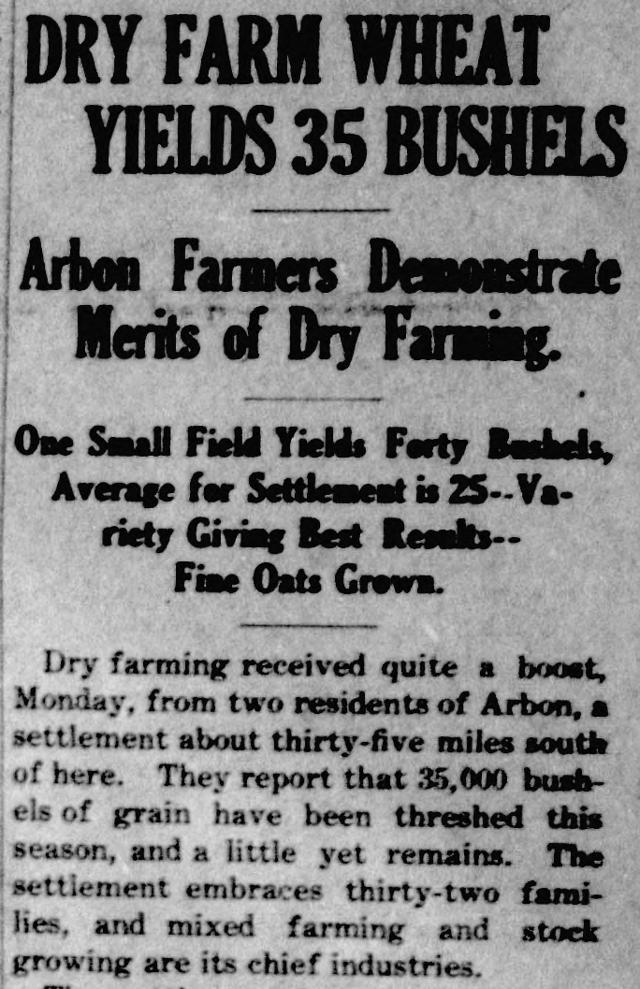
In late November 1907, with a little grain still to thresh, two farmers from Arbon came in to American Falls and gave the American Falls Press the settlement's harvest figures. The paper ran them on its front page of November 30, 1907, under the headline "Dry Farm Wheat Yields 35 Bushels."
Arbon was then in Oneida County, as American Falls was; Power County was not formed until 1913. Dry farming meant raising grain without irrigation, on what rain and snow left in the soil, and the Press was promoting it that year. The same front page reported on a large dry farm near town and on hopes for a government dry-farming experiment station.
What the threshing showed
The two men were Julius Abter and W. F. Arnn, both settlers at Arbon. They reported that 35,000 bushels of grain had been threshed that season in a settlement of thirty-two families, who lived by mixed farming and stock raising. The paper called it a comparatively new settlement, though families had been in the valley since the 1890s, as the Arbon area history tells. Abter had operated the threshing machine, which the paper said let him speak with knowledge of the yields and the quality of the grain; he called the quality the best. The paper summed up the wheat:
Some fields of dry-land wheat averaged thirty-five bushels per acre, and one field of about five acres went forty bushels. The average for the entire settlement, including some very poor fields, is about twenty-five bushels.
John Paine, probably the Arbon settler John H. Payne, was credited with the best wheat: his thirty-five-acre field averaged thirty-five bushels, and five acres of it made forty. Even so, "The grain was damp when threshed, and not all of it was saved." Ezra Anderson, probably Ezra T. Andersen, averaged thirty bushels on thirty-two acres, and Tom Evans, almost certainly Thomas Bowen Evans, twenty-five on sixty acres. Arnn and Abter had each raised oats on new land, fifty and forty bushels, in what the paper said was not a good year for oats; Anderson's oats had made seventy-five bushels the year before.
Page 8 of the same issue added that Tom Evans had threshed 2,500 bushels and Jo Arbon, probably Joseph N. Arbon, 2,450, and that a Horton "on the old Bowen place" had grown fine apples and plums. The paper gave no first name, and several Hortons lived in the valley. Abter and Arnn said they believed "no section of Idaho is better adapted to dry farming than theirs."
Which wheat, and when to sow
The Press thought other dry farmers might learn from Arbon's experience with varieties. Odessa wheat had given the "best results year for year," and more of it was grown than any other kind. Gold Coin had done well in 1906 but proved "very unsatisfactory" in 1907. Spring Sonora was not a sure crop and seemed "much more afflicted with smut than other varieties." Smut, a fungus disease of grain, still troubled the valley's threshers years later, when it caused explosions at threshing time in 1915 and 1924.
Abter also described how the settlers sowed:
"Most of the wheat," said Mr. Abter, "is sown in the fall. Often there is not moisture enough to bring it up, but that appears to make no difference in the yield. We do not worry if it fails to come up, as it seems to suffer no injury by lying in the ground all winter."
A talk at the institute
While in town the two men met Elias Nelson, a federal agricultural official who was arranging a farmers' institute: two days of talks and discussion for farmers, under the direction of the University of Idaho, to be held in the American Falls opera house on December 11 and 12. Arnn was invited to take part in the discussion of dry farming. When the Press printed the program on December 7, the Thursday afternoon session on dry farming included a talk titled "Dry Farming at Arbon," by W. F. Arnn, beside talks on methods of cultivation, the best crops for dry farms and "Idaho's Largest Wheat Farm." The paper said there might be a few changes, and no report of the institute has turned up in the papers read for this post, so whether Arnn gave his talk is not known.
Where the accounts differ
In July 1908 a letter from American Falls in the Blackfoot Idaho Republican reported: "The largest yield reported last year was 45 bushels of wheat per acre. This was grown by C. W. Arnn of Arbon." It counted some 35 or 40 families at Arbon, all dry farming. The initials are probably a misprint for W. F. Arnn, though the Blackfoot paper does not say so. But the figure does not match the Press of November 1907, which credited John Paine with the best wheat, forty bushels on five acres, and gave Arnn's yield only for oats. Which account is right cannot now be settled.
The next harvest
In October 1908 the Press noted that Abter owned the threshing machine at Arbon, and on November 7, 1908, a front-page report on the valley gave that season's yields, as Abter supplied them: 45,000 bushels of wheat, about twenty-five bushels an acre on average, and John Paine near the top again with forty-two bushels of Odessa. The same report counted about forty families near the lower end of the valley. Abter said the best yields came on summer-fallowed land, ground left unplanted for a season to store moisture. That mention of the practice comes eight years before the earliest dated case given in Summer fallowing comes to the valley, George Andersen's eighty acres of 1916. The report ended: "The people are learning how to farm, and yields are increasing every year."
On April 3, 1909, the Press printed on its front page a picture of T. B. Evans's wheat field at Arbon, which it called "far from being the best field" though it had averaged thirty-five bushels an acre. Two weeks later it gave the valley's 1908 average, twenty-five bushels of wheat an acre, "as given by T. B. Evans and Julius Abter, who operated threshing machines."
On this site: The first threshing machines follows threshing in the valley from the borrowed Samaria machine of 1894 onward.
Sources
- American Falls Press, November 30, 1907, page 1
- American Falls Press, November 30, 1907, page 8
- American Falls Press, December 7, 1907, page 1
- Idaho Republican (Blackfoot), July 10, 1908, page 8
- American Falls Press, October 31, 1908, page 4
- American Falls Press, November 7, 1908, page 1
- American Falls Press, April 3, 1909, page 1
- American Falls Press, April 17, 1909, page 1